by Laura Knight-Jadczyk
Copyright 2005, Any portion of this text that is quoted or republished elsewhere must include this notice of copyright and a link to the original article. It may be stored and reproduced for personal, noncommercial use The original photographs of Auch Cathedral are copyright by the author and may be used under the same terms, including a link back to the original article. .
February 19, 2005: At the present time, when millions of people have read the Da Vinci Code, by Dan Brown, it seems that the awareness that man's true history has been hidden is growing apace with the thirst for the truth. In my book, The Secret History of the World, I deal with many branches of the "hidden stream" of knowledge that have periodically emerged into the world during recorded history as the Eleusinian Mysteries, the Orphic Tradition, Gnosticism, Gurdjieff's Fourth Way or "Esoteric Christianity," Catharism, which went underground as the stories of the Holy Grail and Alchemy, etc, linking them to the most ancient traditions from pre-history, including Siberian Shamanism, the "Archaic Techniques of Ecstasy," as Mircea Eliade refers to the matter.
Thus, it is only fair that I warn the reader that this series of remarks will be comprehensible only to individuals well versed in studies of esoteric history and comparative religions, including Gnosticism, Sufism, the Holy Grail, Alchemy, (particularly the mysteries surrounding Fulcanelli), and hermeticism in general. This article plunges directly and immediately into the great mystery. Those who are immersed in Fourth Way Work and who have actually begun to "see" will also recognize the deeper implications of Gurdjieff's work.
For the novice, wishing to gain a foundational understanding, to avoid the glaring misrepresentations of such populist works as The Da Vinci Code, please refer to my other articles: The Grail Quest, particularly the sections that discuss Alchemy and Saint Germain, The Fulcanelli Phenomenon, Rennes-le-Chateau and the Accursed Treasure, The Priory of Sion, and The Ark of the Covenant and the Temple of Solomon. Further reading would include Truth Or Lies, Jupiter, Nostradamus, Edgar Cayce, and the Return of the Mongols, and Commentary on Boris Mouravieff's Gnosis.
Having said all of the above, let me also add that these remarks are by no means exhaustive on ANY point discussed, but are merely an attempt to show, in brief, many disparate connections, and to pique the interest of the reader who may then begin to study the material with a view to deeper understanding..
 |
 |
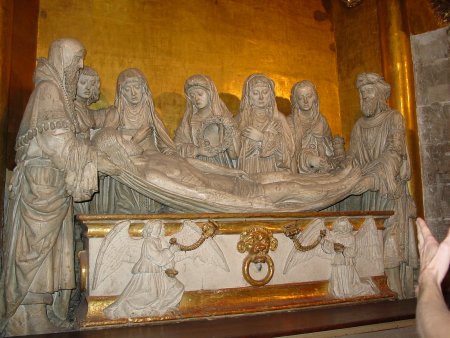
The image above - The Burial of Christ - is from a photograph I made in Auch Cathedral. This Cathedral is dedicated to the Black Virgin.
These two words, suggesting initiation, hide a spiritual reality that is very much alive in the world today. The “Black Virgin” is a hidden presence that can guide the seeker to rebirth. The inscription of dedication of Auch Cathedral is engraved in black marble over the central door, and says “To Mary, the Virgin who is to give birth to God.”
Significantly, it says “who is to…” not “who did…”
There are two representations of the Black Virgin in the Cathedral, suggested by certain details. In chapel 13, as the Sibyl of Samos, (image left) her costume and her face are brown, she is pregnant, and she holds a cradle in her hands.
The other representation is found in the choir stalls, in the canopies, immediately after the panel representing Adam and Eve. It is named Charity. There are two children standing at her feet, waiting and stretching their hands towards her.
A retired priest, Raymond Montané, who has spent his life studying the remarkable esoteric art in Auch Cathedral has written as follows:
It is above all the windows of Arnaud de Moles that deserve our attention. Produced between 1507 and 1513, they are esteemed as the finest of the Renaissance. The famous art critic Emile Male wrote: “For the breadth of thought, no work of this period equals the windows of Auch.”
This extraordinary set includes a series of 18 windows. They are presented as a rich decoration, where a crowd of characters of every origin meet each other. Most come from the Bible, but some of them, like the Sibyls, come from pagan religions. The themes of these story windows have been chosen with the greatest care. To discover the themes, we need to find the golden thread creating an invisible link between heterogeneous characters, apparently strangers to each other.
The visit of these windows must be made from the left to the right, going from the transept, beginning with chapel 11...
An idea brings them together. What is it? The key to this mystery is in the hands of the Sibyl. The object she carries gives us the key to the enigma. This symbolic biblical object concerns each of the characters in a window in some way. It brings them together for a single idea. The artist provoked these encounters to clarify a theme, to illustrate a story...
These windows are not a gallery of merely famous characters. Among the most illustrious, some of them are not there, but some lesser known characters occupy a place of choice. What counts first of all is not the character itself, but the story it evokes, the destiny it attempts to direct. Like the sibyls, each is dedicated to serving a story. They find themselves at the heart, the very crucible...
They come from everywhere, they are from all classes, from every origin. They come willingly like celebrity artists, finding themselves in a gigantic gala, not for their own benefit, but for the benefit of a social and humanitarian task.
These celebrity characters of Arnaud de Moles’ windows contribute, in their own way, to the illustration of the greatest epic, the unfolding of a HISTORY.
Now, a question is asked: What was the real role of Arnaud de Moles, the master glazier, in the realization of the opus that bears his signature?
Arnaud de Moles showed himself truly as a master for the realisation of the kind of screenplay entrusted to him. He was a clever workman formed at the school of the Compagnons - a school that was marked by the techniques of the Middle Ages and the Gothic period. His companions were like him, earnest, available, and applied to their task.
The 18 windows of Arnaud de Moles are therefore an exceptional piece of work. What is truly unique - in this ensemble as well as the choir stalls - is the message that is revealed. Arnaud de Moles was the artist, not the inspiration. The thought was given by unknown patrons...
What first strikes the attentive mind is the wealth and variety of details. The source of this inspiration draws not only on the Bible and the lives of the Saints, but on nature, mythology, pagan religions, the Holy Grail and chivalry. […]
This remarkable set is not mere art! Like the windows, it contains thought, a message.
When we carefully observe the details, in the stalls, something immediately appears to our eyes: Demons and snakes, malevolent animals and monsters of all species swarm there. This invasion contributes to give to this whole a tragic aspect that also agrees very well with the profound movement of history that is narrated to us.
This tragic aspect is complementary and has to be put in relationship to the windows of Arnaud de Moles. The windows and stalls constitute a whole. The two masterpieces were designed at the same time. The same story is told. Its theme was proposed to the glaziers and the sculptors. This theme evokes the same reality: the reality of man in general.
One would almost think about Dante’s Inferno. But this obvious tragedy is not hell - it is the history of humanity on earth. Charity - empty handed - walks right before the monsters and demons, sustained by one same hope, going alone, but courageous, to face evil, the malevolent snake. At the end of the cycle, she becomes triumphant Strength. Her mission is accomplished because we see all malevolent snakes crushed under her feet or finally mastered in her hands.
Since this history is told and relived in retrospect, our artists knew in advance that this dramatic adventure had to bring us to Life.
What breadth! What perspective! that comes out of the thought of the woodwork of the choir of Auch. Some connoisseurs are not afraid to compare the extraordinary work of these stalls with the frescoes of Michelangelo. [Raymond Montané]
I would like to make a note of the fact that, after spending some time trying to find out who Arnaud de Moles actually was, the information I was able to obtain suggests that it was a name given to a group, The Companions Devoted to Liberty, or, perhaps an anagram. In terms of Green Language clues, the name "De Moles" is rich with meaning, ranging from the possibility of homophonic pronunciation "de Molay," as in the last Grand Master of the Templars, as well as the meaning of "mole," which, in French means "stone," or a jetty: a breakwater. In English, the Green Language leads us to a creature that lives underground, or the "going underground" of a tradition. And then, of course, it can also say "Mea Deus Leonard." A reader may find a better solution. There is more, but I don't want to divert onto that subject at the moment because I have a story to tell.
In 2003, we decided for various reasons to re-locate to France. Having previously worked in France at a number of research centers and with a number of French scientists who were enthusiastic about the possibility of Ark's return to Europe, we decided to pursue these mutual research interests.
We longed very much for a peaceful, country life, where we could work, continue our research, and feel safe from the intensifying pressures from various sources that threatened not only our peace of mind, but our very lives.[1] After weeks of studying detailed maps of France, demographics, and so forth, I decided that the area around Auch was where I wanted to be mainly because it was rural and agricultural. And so, we informed our friends in France of this choice and the search for a house was begun. Among our French friends we notified about our choice of location were the Bogdanoff Twins, French TV stars who took a number of years off from their successful careers to obtain their doctorate degrees in mathematics and physics. They were quite excited by the choice since they owned an ancient Chateau near to Auch and had grown up in the region.
When we arrived in France, numb with fatigue and anxiety over so great a change in our lives, I certainly made a mental note of the cathedral next to the real estate agency where we signed the lease for the new place. I was casually pleased to see such an interesting old church would be so close, but I didn’t bother to go inside and look at it. After all, I had been to Notre Dame in Paris! Wasn’t Fulcanelli’s book, Le Mystère de Cathedrales focused on the edifices in Paris, Amiens, and Bourges? What could a cathedral in Auch have to offer?
However, after a question by a visitor from the U.S. (thank you Charlotte), made me curious to see “the famous statues” that I had never heard of, I took the time to go and look. Once I had seen the windows by Arnaud de Moles and the choir, I was so stunned by the clear esoteric import of Auch Cathedral that I could not understand why Fulcanelli had failed to mention it.
It was a puzzle, and it was only over time, as more clues were revealed, as I will explain here, that I realized that it must have been omitted intentionally for the simple reason that it was quite obviously the cathedral with the keys. Fulcanelli was hardly going to give away the keys to the greatest secrets of reality so cheaply that they could be figured out in a year or two by a dilettante. Additionally, according to Fulcanelli, without divine assistance - which we most certainly had via the Cassiopaean transmissions - there could be no hope of solving the mystery. This is one of the precepts of esoteric work that is often overlooked by those who promote themselves as esotericists. The Great Sufi Shaykh, Ibn al-'Arabi points out that one seeker may stand at the door and knock his entire life, and it will never open to him, and another may be admitted with a single request.
In studying the matter we learn that, among the rules that must direct the process of understanding, are the following, each of which leads, in a natural progression, to the next:
1) The Soul must acquire greater powers not only for conception but also for retention, and therefore if we wish to obtain still more knowledge, the organs and secret springs of physical life must be wonderfully strengthened and invigorated. “The Soul must acquire new powers for conceiving and retaining...”
2) In order to respect the principle of hermetism adopted by the Tradition, we must understand that esoteric teachings are given in a sibylline form.
St Isaac the Syrian points out that: The Holy Scriptures say many things by using words in a different sense from their original meaning. Sometimes bodily attributes are applied to the soul, and conversely, attributes of the soul are applied to the body. The Scriptures do not make any distinction here. However, enlightened men understand.
3) “Like attracts like.” When a candidate has developed virtue and integrity acceptable to the adepts, they will appear to him and reveal those parts of the secret processes which cannot be discovered without such help. Those who cannot progress to a certain point with their own intelligence are not qualified to be entrusted with the secrets which can subject to their will the elemental forces of Nature.
Open mindedness, curiosity, and awe of the fact of existence is fundamental my nature and it was, in fact, these very qualities that led me to undertake "Cassiopaean Experiment." A few remarks on this subject are necessary at this point.
After years of working with people's heads via hypnotherapy, I didn't much care whether such things as "past lives" actually existed or not. I only cared that the therapeutic modality worked and gave people relief. My own theory was that it gave them a drama to explain things, to work things out; a way to achieve a resolution by changing the script of the drama. Same with "spirit release therapy."
I incorporated that process in a couple of cases where nothing else worked in the late 80s. I was quite astonished at the results (and was very careful to not contaminate my subjects), and wondered just what the heck was going on? Again, I just explained it to myself that it was a self-created drama that allowed the person to sort themselves out. It didn't matter to me; I wasn't invested in believing any of it. I only cared that it relieved suffering. And it did, every time. It was even a rather simple formulaic process which is why I was so surprised that it worked. Could it be that easy?
My working hypothesis at the time, considering the boring regularity with which subjects from all walks of life came up with the same images, the same types of dramas, the same dynamics in the subconscious mind, was that there was some sort of "field of images," or archetypes to which all human beings were connected in some way. Well, let me make that more precise: people sorted into groups according to which images and dynamics were dominant in their particular case. Jung's work was helpful, but didn't go far enough to explain what I was witnessing.
So, I decided that it would be interesting to access this pure field. That's actually what started the whole thing. Well, how does one access such a theorized field of symbols and dynamics that seems to have some "rule" over people's lives? The obvious answer was some form of "channeling." BUT, there was a catch: I didn't trust anything - and I mean ANYTHING - that would just come into somebody's head - not even my own. I also wasn't interested in talking to alleged "dead dudes" anymore because, by this time, I'd had quite enough of that and if anybody knows they don't have much of interest to say, it was me, (assuming that it is anything other than a drama in the head of the subject).
One of the more interesting theories I came across regarding so-called "channeling" was developed by Barbara Honegger, said to be the first person in the United States to obtain an advanced degree in experimental parapsychology. Honegger suggested that automatism was the result of "stimulation" of the right hemisphere of the brain so that it could overcome the suppression of the left hemisphere. Automatism, as you might know, relates directly to utilizing a device such as automatic writing or a Ouija board type instrument. It was never entirely clear what was doing the stimulating, however and I could obtain no further information on her research. Whether or not the information was supposed to come from the subconscious of the individual or "spirits," was not clearly spelled out. But my thought was that, if it was true that some form of automatism could assist in synchronizing the right and left hemisphere of the brain, that even if it did not result in any real "contact," it was still a worthy exercise.
As I have said, there was an open possibility in my mind that such things as "spirits" were merely fragments of the personality of an individual, sort of like little broken off circuits in the brain running in repetitive loops, created by trauma or stress. Perhaps an individual, when faced with a difficulty, entered a narcissistic state of fantasy, created a "dream," which was imprinted in the memory of the brain. If they then emerged from this state back into dealing with their reality, but not having dealt with the issue itself, it might become locked away in a sort of cerebral file drawer, sitting there, waiting to be triggered by the electricity or neurochemicals of the brain in some random unconscious scan. The same could be said for so- called past life memories; they were merely self-created memory files generated in a state of narcissistic withdrawal due to stress. Such neurological files could then be downloaded and read by using the conscious bypass method of either automatism or simply allowing the conscious mind to "step aside" as in hypnosis. For that matter, simple psychotherapy could be considered channeling in these terms.
Trance channeling is more problematic because it suggests a definite pathological condition. In such cases, the "alter" ego, as either an alternate personality or whatever, is strong and well entrenched enough to establish a far stronger hold on the body of the host than those which can only manifest via automatism or trance. If you don't know what you are dealing with, that's a dangerous experiment to make.
My theory was that whatever the theorized "source" of whatever might be accessible, the method of automatism could be more safely utilized to access the field of archetypal symbols and dynamics that seemed to be the pool from which all people drew in the creation of their personal dramas, leaving aside the question of whether or not those dramas represented anything factual or not. My idea was that if this field could be accessed directly, after playing out and thereby eliminating via feedback, any personal thought loops or memory files, that a great deal of information about the human condition at large might be available.
I continued to dig and read cases and find out everything I could about the subject. That's when I came across one of the first clues about the role of the "standard religions" in suppressing the human ability to access whatever it was - whether it was the subconscious, an archetypal field, or whatever.
It seems that all "primitive" or preliterate cultures had some form of codified communication between "spirits" and the living. Again, let me reiterate that I consider this nomenclature to be simply convention. This phenomenon seems to be universal in the ancient world, and only came under condemnation with the inception of monotheism around 1000 BC. When Yahweh spoke through his channels, they were called prophets and the activity was "divine inspiration". When anybody else did it, it was necromancy or demonic possession, or even just out and out deception. This was because, obviously, since Jehovah/Yahweh was the only god, those other "gods" did not exist, therefore, anyone who claimed to be channeling them was lying. Of course that begs the question as to why people were put to death for lying about communicating with gods that were claimed not to exist? And, if they did actually exist, and were actually communicating, as Yahweh was also, then what status does that suggest about Yahweh, since he was the one who claimed to be the only god and that this was true simply because Yahweh said so via channeling? Most curious.
In the sixth century BC the Thracian Dionysiac cults were known to be using shamans as trance channels to communicate with the spirits, or what were then known as theoi or gods that were said to be discarnate immortal beings with superhuman powers. Some scholars suggest that rationalist philosophy was born out of the Dionysiac, Orphic, and Eleusinian mystery cults devoted to the channeling of these gods; certainly much ancient Greek philosophy, especially that of Pythagoras, Heraclitus, and Plato, was saturated with these mysteries. In Plato's Theagetes Socrates confesses, "By the favour of the Gods, I have since my childhood been attended by a semi-divine being whose voice from time to time dissuades me from some undertaking, but never directs me what I am to do."
The most interesting item of all is the fact that Pythagoras used something like a Ouija board as early as 540 BC: a "mystic table" on wheels moved around and pointed toward signs that were then interpreted by the philosopher himself, or his pupil Philolaus. Even down to the present day, the mysteries of the Pythagoreans are subjects of intense interest to scientists and mystics alike. And here there seems to be evidence that the advanced knowledge of Pythagoras may have been obtained via a Ouija board!
This brings us back to the question, of course, as to how "channeled" information could have been the basis of the Rationalist philosophy that there was nothing to channel? Could it be merely a progression of the idea of Yahweh/Jehovah that there was only one god, and he was it? Just another step in stripping away any spiritual support from the lives of human beings? By the time the Romans had conquered Greece, the rationalist movement was turning against spirit-channeling. My guess is that this was generally a good idea because, without sufficient knowledge and preparation, it can be dangerous.
Cicero, the Roman rationalist whom the early Church Fathers highly revered, railed against spirit-channeling or necromancy on the grounds that it involved ghastly pagan rituals. Perhaps, by that time, it did. Just look at the whole New Age/Spiritualist movment today. What a morass.
What seems to have happened is that, eventually, rationalism bit the hand that fed it and began to devour its father, monotheism, by further extending the argument to the idea that there is no god, there are no spirits, nothing survives the death of the physical body, so there is really nobody for us to talk to on the "other side," so why bother? Science took the view that the whole thing was a con game, and that's pretty much the current mainstream scientific opinion of the phenomenon today.
Nevertheless, as I noted: I thought it would be interesting to try to access the "pure field of archetypes." I knew it would take time to run out all the loops - whether spirits or just subconscious dramas - and that patience and persistence was important. And so, I settled down to do it, and it took over two years.
Ark writes: The name Cassiopaea was given by a consciously "channeled source" which Laura accessed in 1994 after two years of experimental work. The source identified itself by saying "we are you in the future." Modern physics does not provide us with practical means for this type of communication, and theories on this subject are not well developed; they are, in fact, inconclusive and controversial.
When interpreting "we are you in the future in an oversimplified way, we are faced with causal paradoxes. On the other hand, from the theoretical papers published in physics journals we can learn that, with a proper and careful interpretation, and taking into account quantum uncertainties, communication into the past cannot be dismissed as impossible. Improbable perhaps is the right word, but there are many things that are improbable and yet happen. The more improbable is a given phenomenon, the more information is carried by its occurrence, the more we can learn by its study. That is why we did not dismiss the "we are you in the future" as impossible and therefore ignorable. Instead we decided to continue the "communications" as a form of a controlled experiment in "superluminal thought transfer" – even if it was clear that the term should be considered as a tentative indication of only one out several possible interpretations.
The information received from this experiment is presented in the context of broad ranging historical, scientific and other metaphysical material and offers the clues that have led to the world view and inferences presented by us in our numerous publications on this website and in print. Perhaps it is only our own "subconscious mind" that presents itself as a "source," but even if it is so, does that tell us more? Do we really know what "unconscious mind" is and of what is it capable?
Returning now to the subject at hand: I continued to marvel at Auch Cathedral, I began to realize fully, for the first time, that the Cassiopaean Transmissions was just such an “appearance of the adepts.” It finally began to dawn on me that the process I had followed, instinctively, had been quite accurately described by Eugene Canseliet in his Preface to the second edition of Fulcanelli’s The Dwellings of the Philosophers:
According to the meaning of the Latin word adeptus, the alchemist has then received the Gift of God, or even better, the Present, a cabalistic pun on the double meaning of the word, underlining that he thus enjoys the infinite duration of the Now.[...]
In the Kingdom of Sulpur (cabalistically: Soul Fire) there exists a Mirror in which the entire World can be seen. Whosoever looks into this Mirror can see and learn the three parts of Wisdom of the entire World.
July 14, 1996
Q: (L) In other words, as long as we are in the pigstye, we are in the pigstye, and until we get OUT of it, we are IN it?
A: Until you reach that point on the learning cycle. [...] "Passion" does not set one "free," quite the opposite!
Q: (L) But what if your passion is for knowledge?
A: That is not passion, it is soul questing.
Q: (L) What is it that gives some people this drive, this steamroller effect that they are determined to get to the absolute bottom of everything and strip away every lie until there is nothing left but the naked truth? What is the source of this desire?
A: Wrong concept. It is simply that one is at that point on the learning cycle. At that point, no drive is needed.
Q: (L) So, you more or less are there because some critical mass has been reached that 'jumps' you to the point where seeking truth is simply who you are? It defines the parameters of your being.
After thirty years of study and two years of dedicated experimentation, detailed in my autobiography, Amazing Grace, the Cassiopaean communications began: I began to look into the Mirror in which the entire world can be seen..
“We are you in the Future,” they said. “We transmit ‘through’ the opening that is presented in the locator that you represent as Cassiopaea, due to the strong radio pulses aligned from Cassiopaea, which are due to a pulsar from a neutron star 300 light years behind it, as seen from your locator. This facilitates a clear channel transmission from 6th density to 3rd density... [in] "Zero" time [utilizing Electromagnetics and gravity which are interconnected, or you could say "unified". Space and time are selective and flexible. ... You see, when one utilizes zero time, there is zero space as well."
In short, the Cassiopaean Transmission was initiation preparatory to receiving the "Gift of the Present."
After living in the Gers for 11 months, we found a more permanent - and safer - house with all the features we needed for our work. We moved in and shortly discovered that one of our neighbors was Patrick Rivière, a noted historian and author of many books on the subject of comparitive religions, alchemy and the Holy Grail. He is also an expert on the "Rennes-le-Chateau" phenomenon. Patrick also happened to be a student of Eugene Canseliet, the disciple of Fulcanelli. We dispatched a note to him and were very happy to receive a call a couple of days later suggesting a meeting. It seems that Patrick had been "waiting" for us. His own studies and lifelong work had brought him to the point where he knew that "The Sybil Would Appear when the time was right." This was the beginning of our collaborations.
I was very anxious to query Patrick about any clues to the true identity of Fulcanelli. I had read many theories about this, but due to a particular clue that was dropped almost casually by Eugene Canseliet in his description of his visit to the “enclave of the alchemists” in Spain, I was convinced that Fulcanelli was a single individual, not a “committee” as some materially minded thinkers propose, and that he had, indeed, achieved the “Great Work.” Patrick agreed and responded that he knew the identity of Fulcanelli, and that he had written a small book on the subject in French that was not yet available to English speaking audiences, Fulcanelli in the “Qui suis-je?” series. [Red Pill Press will be bringing out Patrick's work in English soon.]
We spent many pleasant hours with Patrick at table going over his process of discovery, his reasoning, and looking at the documentation he had collected over the years. This man has truly devoted his entire life to this work. In the end, I was convinced that Patrick is quite right: the true identity of Fulcanelli was Jules Violle, a famous French physicist of the 19th century. As noted, Patrick's own work on this subject is being translated and I will leave it to him to describe his process of discovery. It was what we discovered together, after receiving this clue that is most important to discuss here. It is, in fact, I believe, the solution to the "Da Vinci Code."
Jules Violle was a graduate of the École Normale Supérieure at Paris, he taught at the University of Lyon (1883), then at the École and, from 1891, at the Conservatoire des Arts et Métiers, Paris. He made the first high-altitude determination of the solar constant on Mont Blanc in 1875. The “violle” is a unit of light intensity equal to a square centimeter of platinum, glowing at its melting temperature of 1769 °C (3216 °F). It was the first unit of light intensity that did not depend on the properties of a particular lamp.
When I read this, my mind immediately went back to an excerpt from the Cassiopaean Transmissions:
June 21, 1997
A: Alfalfa fields in Rhineland yield as of yet undreamed of treasures.
Q: Where are these alfalfa fields?
A: Near tracks well worn.
Q: [...] Do you mean Rhineland as in Germany proper?
A: We do not mean Rhinelander, Wisconsin... Or do we?!? Who is to tell?
Q: Who?
A: The searcher, the sepulcher, the one who carries the staff in constant search for greener pastures.
Q: Oh my! You are being VERY obscure tonight! [...] any additional clues for me or Ark?
A: Last clue for tonight: Look for the vibratory frequency light. Good Night.
I suddenly realized that the funny remark about "Rhinelander, Wisconsin" pointed directly at France - the land of a Thousand Cheeses - because, to the American mind, Wisconsin is "the land of Cheese." I later learned that the Garonne River was referred to as "The Rhine of France." And then, of coure, there are "rhinds" on cheeses. But the icing on the cake was, of course, "look for the vibratory frequency of light" and the Violle: the first unit of light intensity that did not depend on the properties of a particular lamp.
As I began to dig into the background of Jules Violle, I discovered another significant clue: he was closely associated with Camille Flammarion, French astronomer and popular author. Flammarion was the founder of the French Astronomy Society, and he served for many years at the Paris Observatory and the Bureau of Longitudes. Flammarion set up a private observatory at Juvisy (near Paris) in 1883 and his studies were particularly focused on double and multiple stars - a particular focus of the Cassiopaean Transmissions - and of the moon and Mars. It is easy to see that Violle and Flammarion had a lot in common, particularly their interest in stars. Double and multiple Stars gives Fulcanelli's dedication “To The Brothers of Heliopolis” an all new level of meaning!
When examining the life and associations of Camille Flammarion, additional clues began to finally fit together: he was an associate of, and greatly influenced by, Allan Kardec, the French Pedagogue, medical student, linguist and researcher of “spirit communications.”
In the spring of 1858 Kardec founded the Societe Parisienne des Etudes Spirites. In the late 1850s and early 1860s, small Spiritist groups began to proliferate throughout France, especially in Paris, Lyon and Bordeaux.
Camille Flammarion remarked: “I have no hesitation in saying that he who states that spiritist phenomena are contrary to science does not know what he is talking about. Indeed, there is nothing super-natural in nature. There is only the unknown: but what was unknown yesterday becomes the truth of tomorrow”.
Victor Hugo, another advocate of scientific spiritualism said: “Turning a blind eye to the spiritist phenomena is turning a blind eye to the truth”.
The Societe Parisienne was similar to the Society for Psychical Research in London, a body devoted to unbiased inquiry. Kardec’s efforts were largely focused on promoting the impartial and rational study of spiritual matters. The Spiritist views of Kardec were scientific, not mystical; and he promoted objective discovery over intuitive insight just as the Cassiopaean Transmissions and our own work does.
Turning now to the comments on millenarialism in the works of Fulcanelli, it is interesting to note that Kardec’s final book, La Gazette selon le Spiritisme, appearing in 1868, strongly reflected the millenialist view. The work closed with a series of communications and commentaries declaring that “the time chosen by God has come,” stating that a new generation of highly-evolved souls was in the process of being incarnated on Earth.
This is precisely what Fulcanelli stated in the mysterious Hendaye chapter of Mystery of the Cathedrals as well as in the final chapters of Dwellings of the Philosophers. We also note that Fulcanelli emphasized the role of science in the so-called “End Times” as being crucial. Not only was Jules Violle a scientist, but my husband Ark, is a scientist: an expert in Hyperdimensional Physics, nonlinear dynamics and complex systems.
Finding a well established link between Flammarion and Jules Violle, followed by a well established link between Flammarion and Kardec, gives an entirely new perspective on the work of Violle as Fulcanelli. It also leads us to the very important question: Is it possible that Fulcanelli made use of “superluminal communication techniques” as I had myself? Was this why Fulcanelli insisted as follows:
"Furthermore, in our opinion, it seems insufficient to know how to recognize and classify facts exactly; one must still question nature and learn from her in what conditions and under the control of what will her manifold productions take place. Indeed, the philosophical mind will not be content with the mere possibility of identifying bodies. It demands the knowledge of the secret of their elaborations. To open ajar the door of the laboratory where nature mixes the elements is good; to discover the occult force, under whose influences her work is accomplished, is better. […]
"Alchemy is obscure only because it is hidden. The philosophers who wanted to transmit the exposition of their doctrine and the fruit of their labors to posterity took great care not to divulge the art by presenting it under a common form so that the layman could not misuse it. Thus because of the difficulty one has of understanding it, because of the mystery of its enigmas and of the opacity of its parables, the science has come to be shut up among reveries, illusions and chimeras. […]
"With their confused texts, sprinkled with cabalistic expressions, the books remain the efficient and genuine cause of the gross mistake that we indicate. For, in spite of the warnings... students persisted in reading them according to the meanings that they hold in ordinary language. They do not know that these texts are reserved for initiates, and that it is essential, in order to understand them, to be in possession of their secret key. One must first work at discovering this key.
"Most certainly these old treatises contain, if not the entire science, at least its philosophy, its principles, and the art of applying them in conformity with natural laws. But if we are unaware of the hidden meaning of the terms - for example, the meaning of Ares, which is different from Aries - strange qualifications purposely used in the composition of such works, we will understand nothing of them or we will be infallibly led into error.
"We must not forget that it is an esoteric science. Consequently, a keen intelligence, an excellent memory, work, and attention aided by a strong will are NOT sufficient qualities to hope to become learned in this subject.
Nicolas Grosparmy writes: 'Such people truly delude themselves who think that we have only made our books for them, but we have made them to keep out all those who are not of our sect.'
"Batsdorff, in the beginning of his treatise, charitably warns the reader in these terms: 'Every prudent mind must first acquire the Science if he can; that is to say, the principles and the means to operate. Otherwise he should stop there, without foolishly using his time and his wealth. And so, I beg those who will read this little book to credit my words. I say to them once more, that THEY WILL NEVER LEARN THIS SUBLIME SCIENCE BY MEANS OF BOOKS, AND THAT IT CAN ONLY BE LEARNED THROUGH DIVINE REVELATION, HENCE IT IS CALLED DIVINE ART, or through the means of a good and faithful master; and since there are very few of them to whom God has granted this grace, there are also very few who teach it.'" [Fulcanelli, The Dwellings of the Philosophers (Boulder: Archive Press 1999) pp. 49, 65, 84]
In view of this question, it might be useful to look at excerpts from an article written by Camille Flammarion, the friend and associate of Jules Violle and Allan Kardec which reflects our views exactly:
Spiritism is, in general, in bad repute, and deserves to be. Most of its disciples are unmethodical; they are often lacking in mental poise, are often dupes of illusions. They prefer a belief and a religion which merely console, to the impartial and critical investigation without which we can be sure of nothing. These are bad conditions for research; adequate safeguards are lacking.
In Allan Kardec’s time (in the course of the speech which I made at his grave on April 2, 1869) I believed it helpful and even necessary to proclaim, at this very grave, that “spiritism is not a religion but a science,” and to add that “we are now at the dawn of an undiscovered science.” During the fifty years which followed the utterance of these words, the continued progress of our research has lent them greater and greater emphasis, confirmed them more and more fully.
It is by the scientific method alone that we may make progress in the search for truth. Religious belief must not take the place of impartial analysis. We must be constantly on our guard against illusions.
Apart from deliberate deception, dishonest and inexcusable, there is autosuggestion leading to involuntary deception. [...]
There are also dishonest exploiters of credulity, who give “séances,” promising apparitions and posthumous manifestations to the simpletons who listen to them. Those who have been gulled then complain, laughably, of having been robbed! The human race, supposedly intelligent, is truly strange. One must have a great deal of courage to work perseveringly, surrounded by these impostors; one must be sustained by the conviction that there are truths to be discovered. […]
[Camille Flammarion’s Death and Its Mystery - After Death. Manifestations and Apparitions of the Dead; The Soul After Death Translated by Latrobe Carroll (1923, T. Fisher Unwin, Ltd. London: Adelphi Terrace.]
Flammarion makes a profound distinction between “spiritualism” and “spiritism.” By “spiritualism” he means the general doctrine that departed spirits hold intercourse with mortals. By “spiritism” he means mediumistic research.
As we continued to examine and discuss the documents Patrick Riviere had collected, including many that he only reveals in his book on the identity of Fulcanelli, the talk naturally turned to the third book of Fulcanelli that was withdrawn: Finis Gloria Mundi. This book has been the subject of much speculation, and I hear that someone has actually published a volume claiming to be the “real deal.” It’s clear from the evidence that this is not the case, that the book in question is a fraud.
The title of this Third Book of Fulcanelli, Finis Gloria Mundi (The End of the Glory of the World), certainly reflects the millennialist perspective which I discuss at some length in The Secret History of The World. As we went over the notes and outline that were in the possession of Eugene Canseliet at his death, we came to the realization that my own book, The Secret History of The World, may be quite close in content and structure to the actual Finis Gloria Mundi though it is certainly, again, a strange coincidence. Certainly, all of the chapter headings of that book cover the subjects in Secret History, only I believe I have actually gone further given the new data available in the intervening years. Patrick has written about my own book as follows:
This book of revolutionary importance is essential reading. [...]
Throughout her exposé, Laura Knight-Jadczyk refers to two powerful works of the scientist-alchemist Fulcanelli: The Mystery of the Cathedrals and Dwellings of the Philosophers. She applies her vast knowledge to the continuation of his work.
Thus, following in the footsteps of Fulcanelli (citing Huysmans) when he denounces the constant lies and omissions from official History over the course of time, Laura Knight-Jadczyk, citing numerous examples, exposes the manipulations in the official history of ancient civilizations of which humanity is the victim. She strives to re-establish the truth, and her answers are often enlightening.
According to Laura Knight-Jadczyk, the mysteries of the Holy Grail and the Ark of the Temple refer to a particular, very advanced "technology" - with the aim, for example, of teleportation and changing between space-time dimensions - a secret and sacred science of which only a few great "Initiates" have remained custodians. Christ Jesus was the surest guarantor of this precious legacy, and, although it might displease Dan Brown (author of The DaVinci Code), the genealogical lineage of the "Sangréal" (the "Sang Royal" or "Holy Blood"), is not at all as he believes it to be!
The reader of this important work by Laura Knight-Jadczyk will realize that there are completely different conclusions to that mystery. Her erudition cannot but impress the reader during the course of an assiduous reading of this quite astonishing book.
As to her inspiration, what can we say, and, from whence could it come, if not the Light of the stars? [Patrick Rivière's Preface to The Secret History of the World]
Rivière has speculated in our conversations that Fulcanelli withdrew the book because he did not have proof of certain scientific elements and, as a scientist, did not wish to promote ideas for which there was no evidence at the time. While I consider this to be a valid argument, with the hyperdimensional perspective factored in, it seems more likely that Fulcanelli withdrew the book because he knew it was not yet time. Those who have received the Gift of God, the Present, can certainly “see the unseen” including future probabilities.
Another interesting clue was discussed among us. At one point, we were discussing Canseliet’s visit to Seville where he encountered Fulcanelli as a young girl. The issue of our discussion was: what was the meaning of this event and was it intended to convey a message? And if so, to whom? It certainly was the one thing that conveyed to me reams of information about the nature of the Great Work. In 1995, the Cassiopaeans had described some of the effects of a "4th density bleedthrough" on 3rd density humans in the following way:
4th density frees one from the illusion of "time" as you WILL to perceive it. Picture driving down a highway, suddenly you notice auras surrounding everything.... Being able to see around corners, going inside little cottages which become mansions, when viewed from inside... Going inside a building in Albuquerque and going out the back door into Las Vegas, going to sleep as a female, and waking up male... Flying in a plane for half an hour and landing at the same place 5 weeks later... Picture driving to reach New Mexico by car and "skipping" over and arriving in San Diego instead, or... driving to the grocery store in Santa Fe, and winding up in Moscow, instead.
As we examined every aspect of the event, it came out that the incident occurred when I was 2 years old, exactly at the time that, as I have described in my autobiography, I disappeared and then reappeared in a very strange manner that is still inexplicable to this day. Then, of course, there is the mysterious "Hendaye Chapter," which was included in the Second Edition of Mystery of the Cathedrals concommitant with the withdrawal of Finis Gloria Mundi.
One evening, as we discussed Fulcanelli around the fire in Patrick's charming farm-house, alchemical laboratory, warming our glasses of amber Armagnac in our hands, Patrick mentioned "Hendaye." My brain suddenly snapped to attention. "What did you say?" He repeated the word and I suddenly understood something quite profound. You see, the word "Hendaye," pronounced by a native Frence speaker sounds very much like "Onde," which is French for "Wave." I had begun The Wave Series in 1999 and worked on it well into 2000 before an offer was made to translate it into French, at which time I learned the French word "Onde." But I had never heard it properly pronounced before.
So, with this sudden realization, put together with the other clues that were, one by one, revealing themselves to us, we began to speculate on the real reason for Fulcanelli to have written this piece which, essentially replicates most of the same information he includes in his final chapters of Dwellings of the Philosophers. Could the reason have been purely "Green Language," to relate The Wave to Onde via Hendaye? Was it a clue specifically for us, at that moment in space/time, when the "right people" with the right keys were all brought together in the peaceful French countryside overlooking the Garonne River, the "Rhine of France?"
Undreamed of Treasures indeed!
In any event, the title of Fulcanelli’s Third Book was taken from a painting that is found in Seville. We began to discuss a proposed trip to Seville to visit the place where Canseliet had this meeting with Fulcanelli and to view the painting. It was at this point that I noted the interesting fact that, following the rules of language changes, the word “Seville” was very similar to Sibyl. Another "Green Language clue" just for us? That brings us back to Auch Cathedral and its many Sibyls which led to even more discoveries - even, in fact, the True Da Vinci Code.
A single Sibyl is first mentioned about 500 B.C. by Heraclitus: “The Sibyl, with frenzied mouth uttering things not to be laughed at, unadorned and rough, yet reaches to a thousand years with her voice by aid of the god.”
Later, there were more Sibyls; Christians in the late middle ages recognized as many as twelve. The most famous sibyls were the Erythraean and the Cumaean. There is some confusion as to whether they were always young and virginal, or old hags. The Cumaean sibyl was alleged to have lived for nearly a thousand years, at the end of which, all that was left of her was her voice, kept in an empty jar. One has to wonder about this in terms of the images of Mary Magdalene and her "alabaster jar" and the possible Green Language clues there. In any event, the fame of the Cumaean sibyl was due to Virgil’s use of her in the Fourth Eclogue to foretell the birth of a saviour (40 B.C.) and as Aeneas’ guide to the underworld in Book Six of the Aeneid. This, curiously, leads us back to Fulcanelli.
Canseliet writes in his first preface to Mystery of the Cathedrals:
I know, not from having discovered it myself, but because I was assured of it by the author more than ten years ago, that the key to the major arcanum is given quite openly in one of the figures, illustrating the present work. And this key consists quite simply in a colour revealed to the artisan right from the first work.
In his introduction to the Second Edition, Canseliet tells us that Basil Valentine was Fulcanelli’s initiator - and makes the point of distinction between “first initiator,” and “true initiator.” That could certainly indicate the difference between a "human" teacher" and a "hyperdimensional" teacher. He then discusses a letter that was left by Fulcanelli after he “died,” and which he says was obviously received by Fulcanelli’s master from some unknown individual, and which Canseliet said was the “written proof of the triumph of his true initiator,” which provides a “powerful and correct idea of the sublime level at which the Great Work takes place.” This letter has a number of remarkable references which suggest to me that it may not be a letter to Fulcanelli’s master, but was to Fulcanelli himself, and may have referred to his attempts to communicate with Basil Valentine directly via techniques learned from Kardec via Flammarion. The references that suggest this to me are:
This time you have really had the Gift of God; it is a great blessing and, for the first time, I understand how rare this favour is.[…]
When my wife told me the good news… I was only briefly informed about the matter…[…]
You have extended generosity to the point of associating us with this high and occult knowledge, to which you have full right and which is entirely personal to you. […]
My wife, with the inexplicable intuition of sensitives…
One can almost say that he, who has greeted the morning star, has forever lost the use of his sight and his reason, because he is fascinated by this false light and cast into the abyss… Unless, as in your case, a great stroke of fate comes to pull him unexpectedly from the edge of the precipice.
For me, this "great stroke of luck" that pulled me from the precipice was the Cassiopaean Transmissions. They have done it more than once! I would like to point out that the "familiarity" of the remark "You have extended generosity to the point of associating us with this high and occult knowledge, to which you have full right and which is entirely personal to you" struck me in a profound way in regard to this. The reader might wish to read Ark's comments on "Reductio ad Absurdum" to understand exactly what this phrase can refer to, not to mention The Adventures Series which describes a period in which I was perilously close to being entrapped in a pit .
Returning to Canseliet's preface to the second edition of Mystery of the Cathedrals, we find that he continues on with a discussion of the “star” in question asking:
Does not this phrase apparently contradict what I stated twenty years ago… namely that the star is the great sign of the Work; that it sets its seal on the philosophic matter; that it teaches the alchemist that he has found not the light of fools but the light of the wise; that it is the crown of wisdom; and that it is called the morning star? […]
It may have been noted that I specified briefly that the hermetic star is admired first of all in the mirror of the art or mercury, before being discovered in the chemical sky…
Our star is single and yet it is double. Know how to distinguish its true imprint from its image and you will observe that it shines with more intensity in the light of day than in the darkness of night.
This statement corroborates and completes the no less categorical and solemn one made by Basil Valentine (Douze Clefs):
‘Two stars have been granted to man by the Gods, in order to lead him to the great Wisdom; observe them. Oh man! And follow their light with constancy, because it is Wisdom.’[…]
There are, then, two stars which improbable as it may seem, are really only one star. The star shining on the mystic Virgin - who is at one and the same time our mother (mère) and the hermetic sea (mer) - announces the conception and is but the reflection of that other, which precedes the miraculous advent of the Son. For though the celestial Virgin is also called stella matutina, the morning star; though it is possible to see on her the splendour of a divine mark; though the recognition of this source of blessings brings joy to the heart of the artist; yet it is no more than a simple image, reflected by the mirror of Wisdom.
Canseliet continues to give clues for the seeker to figure out what he is talking about, followed by a story designed to confuse those who are more materially minded. In short, he introduces a deliberate obfuscation. Canseliet then says:
The reader may be surprised that I have spent so much time on a single point of the Doctrine… However, it must be obvious how logical it was for me to dilate on this subject which, I maintain, leads us straight into Fulcanelli’s text. Indeed, right from the beginning my Master has dwelt on the primary role of the star, this mineral Theophany, which announces with certainty the tangible solution of the great secret concealed in religious buildings…
The remark: "Mineral Theophany" struck another spark with the Cassiopaean Transmissions where I had asked a few brief questions about a dream I had. But first, let me recount the dream from my journal:
There was a "high priest" who appeared in my dream wearing a skirt like the Cretan depictions of the goddess with the many tiered skirt... only this was a man. He showed me how the different tiers could be "rotated" so that certain "symbols" aligned which then gave a message. The symbols were zodiacal and the star names were of great significance. The trick was, to align them properly.
The same dream then morphed. I was holding a vase that appeared to be onyx or something like that. Others had tossed it on a junk heap and I picked it up and was examining a lot of "scratch" marks all over it. I could see that it was engraved all over, but that all the grooves were filled with dirt and it was coated with grime. I began to clean it with Q-tips and water very carefully going into all the little cracks and tracing out all the lines. As I did so and the dirt came away, I was awestruck at the beauty of this thing. It was not only cunningly worked with some great mythical scene being enacted, but it was inlaid with amazing veneers of various colored stones... and, it was also translucent so that the "blackness" turned out to be really a deep, translucent purple as though there was a light within.
The dream morphed again: Ark and I were walking and it seemed to be a sort of "park" or "recreation" area of some sort with mountains and cliffs and so forth. We were walking about looking at rock formations and shrubbery - it was very dry and needed water - and he was walking along a path and I decided to hide in a bush and see how long it took for him to notice I was missing... just playing... but I suddenly found myself standing on the path AHEAD of him... and he asked "how did you do that?" So, I said... well, I ducked into this bush and there was a cleft in the rock, and I started to squeeze into it and something happened and here I am!
He insisted that I go back and show it to him. So, we went back and there was a small cave entrance... looking rather like the broken cleft of the tomb in the Arcadian Shepherd's painting. He said that it was impossible... too small ... I told him "try it."
So, he stooped down and entered the cave... meanwhile, I decided to stay busy by cleaning all the cracks in the rocks around the cave entrance... there was a trickle of water and I was using some sort of cloth... and as I did, the water kept increasing its flow until it was a veritable fountain! At this point, Ark came stumbling out of the cave, holding his eyes, crying tears and laughing at the same time saying "I believe! I believe! I've seen it with my own eyes!" and that sort of thing.
So, we started to leave the park and as we were walking out the entrance, I glanced up at the cliff face and there was a HUGE mosaic set in the rock... on the right were seven sharks... the bottom one was pale and they got darker as they went up... stacked, exact same images... and on the left was a HUGE whale depicted in the act of "whipping around" with his mouth opening, his eye on the sharks and preparing (by implication of the frozen posture) to devour them all at one bite. I told myself that I needed to remember this dream and woke up.
July 19, 1997
Q: I had a dream the other night. As Ark and I were leaving [a large park area] in my dream, I looked up and saw a mosaic on the side of the mountain. It had seven sharks, one above the other, the lowest being pale almost to the point of transparency, and the highest being very dark and intense in color. There was a HUGE sperm whale to the upper left, he was in the posture of whipping around, his eye had caught the sharks, and his mouth was open and he was going to swallow them all in a single gulp. What was the meaning of the whale and the sharks?
A: Logic.
Q: Are you telling me to use logic, or that the meaning IS logic?
A: Logic says to you: examine!
Q: The other part of the dream was that I disappeared and reemerged from a cleft in a rock. I was cleaning... [Ark] went to investigate [the cleft which was just a slit and impossible to enter or exit from]... [while he was gone, I continued to clean out all the little cracks and crevices in the rocks on the ground] and he returned and was crying and all this water was flowing out of there like a spring that seemed to have resulted from my cleaning efforts... What was the significance of this?
A: Trace minerals interact with deeply held secrets.
Q: The other night you said something about what I had found as being one leg of the table. How many legs does the table have?
A: Search for answer. When found in literature, profound meanings enclose compartment.
I hope that this contributes to the reader's understanding of Canseliet's remark: "this mineral Theophany, which announces with certainty the tangible solution of the great secret concealed in religious buildings…"
Feb 19, 2000
Q: Diodorus Siculus, writing in the 1st century B.C., said that "certain sacred offerings wrapped in wheat straw come from the Hyperboreans into Scythia, whence they are taken over by the neighboring peoples in succession until they get as far west as the Adriatic. From there they are sent south, and the first Greeks to receive them are the Dodonaeans. Then, continuing southward, they reach the Malian gulf, cross to Euboea, and are passed on from town to town as far as Carystus. Then they skp Andros, the Carystians take them to Tenos, and the Tenians to Delos. That is how these things are said to reach Delos at the present time."
So, from very ancient times, there was this practice of the Hyperboreans sending sacred offerings to the Island of Delos. Now, the Island of Delos is supposedly the birthplace of Phoebus Apollo, whose mother was Leto. Supposedly he was born on Mt. Cynthus. This is a very curious thing. This is contrary to the old view that the cultural flow was from the Mediterranean to the North, that civilization began in the Near East. It implies a cultural flow from the North to the South. What were these ancient Hyperboreans sending to the Island of Delos?
A: Leaves bearing cryptic codes.
Q: What was the connection between the Hyperboreans, including the Celts of Britain, I believe, and the people of Delos?
A: Northern peoples were responsible for civilising the Meditteranean/Adriatic peoples with the encoded secrets contained within their superior extra-terrestrially based genetic arrangement. Practice of which you speak was multi-trans-generational habit.
Q: Is it the case that some of them communicated with higher density beings via Stonehenge, and that these communications they received...
A: Stonehenge used to resonate with tonal rill, teaching the other wise unteachable with wisdoms entered psychically through crown chakra transceiving system.
This brings us back in a curious way to my profound understanding of the previously mentioned comment made in the letter left by Fulcanelli: "You have extended generosity to the point of associating us with this high and occult knowledge, to which you have full right and which is entirely personal to you. If the reader has had a look at "Reductio ad Absurdum" and related links, then this exchange will not only fill in a few blanks, it will reveal the terrible struggle that must be sustained by one seeking truth. "Frank" is a pseudonym for the individual who embarked with me on the experiment that led to the Cassiopaean Transmissions. He was present at nearly every session (but not all, and certainly, the experiment has continued with even greater clarity and more profound discoveries for the past five years), and the experiences we had with him and subsequent events, only clarified Fulcanelli's tactics for us.
Jan 10, 2002
Q: As you know, we have become aware this evening of Frank's extraordinary conversion to the dark side. Is that an accurate way of perceiving it?
A: Close enough.
Q: Quite a few years ago, there were several remarks made on two or three occasions regarding Frank's battle with the Dark Forces, and the issue of whether or not he would be able to resist their domination. Was it always known that he would fail?
A: He is not a failure.
Q: What do you mean?
A: From the perspective of [the forces of Entropy] he is a success.
Q: Why was it that we were able to [receive creative] material, with Frank being so borderline regarding this ultimate choice between [Entropy and Creation]?
A: He was programmed for the specific purpose of "downloading" from you secrets coded into you before birth of your present body. He failed because you were incorruptible. He is now charged with the mission, in concert with Vincent Bridges, of destroying your ability to accomplish your mission.
Q: Well, that means that there is a strong possibility that the material that came through while Frank was a participant was very likely corrupted. Is that why you gave the figure of 72 percent purity of the material regarding those sessions?
A: Yes.
Q: So, are you saying that Frank's presence produced that 30 percent corruption?
A: Yes.
Q: What was the form that most of that corruption took? Can we identify it?
A: Predictions and terror tactics.
It was certainly only AFTER the exit of Frank, and after the exposure of Vincent Bridges as an "esoteric poseur," to understate the matter, that the Work moved to it's present level of intense work and gathering support from around the world.
So, let me return now to the remarks about stars made by Canseliet made 20 years apart, that, juxtaposed, reveal something quite marvelous:
From the FIRST edition: I know, not from having discovered it myself, but because I was assured of it by the author more than ten years ago, that the key to the major arcanum is given quite openly in one of the figures, illustrating the present work. And this key consists quite simply in a colour revealed to the artisan right from the first work.
I suspect that the reader has, by now, figured out that Canseliet and Fulcanelli were very tricky. And so, we look at this clue and try to think of what Canseliet is saying. He says that the clue is in a “figure illustrating the present work,” that it is revealed “right from the first work” and in the preface to the second edition, adds the clue that the subject of the star “leads us straight into Fulcanelli’s text” saying that “right from the beginning my Master has dwelt on the primary role of the star…”
We turn to the very beginning of Fulcanelli’s text where he writes:
The strongest impression of my early childhood - I was seven years old - an impression of which I still retain a vivid memory, was the emotion aroused in my young heart by the sight of a gothic cathedral. I was immediately enraptured by it. I was in an ecstasy, struck with wonder, unable to tear myself away from the attraction of the marvellous, from the magic of such splendour, such immensity, such intoxication expressed by this more divine than human work.
Never does he mention a star. He mentions no color. He makes no reference to an illustration.
Or does he?
What he does talk about is his emotional state, his ecstasy, and his age: Seven. It occurred to me as I meditated upon this matter, that a number is also a figure, and that the use of an “impression of childhood” is certainly an “illustration.” So, there is, indeed, a “figure illustrating” something that might be a “key” to the “major arcanum.” SEVEN and ECSTASY.
What to do with the number Seven?
I simply turned to chapter Seven and began to read.
Varro, in his Antiquitates rerum humanorum, recalls the legend of Aeneas saving his father and his household gods from the flames of Troy and, after long wanderings, arriving at the fields of Laurentum, the goal of his journey.
Fulcanelli inserted a footnote to the word Laurentum, at the beginning of chapter Seven of Le Mystere telling us that “Laurente (Laurentium) is cabalistically l’or enté (grafted gold)”. And so indeed, we have been led to a color! Not only that, but a color that reflects my very name. There is another interesting reference to the number seven in the Cassiopaean Transmissions:
July 26, 1997
Q: ... Now, when the Templars were arrested, they were accused of worshipping a head, or skull, and also the god Baphomet. Were thes spurious accusations designed to defame them?
A: Skull was of pure crystal.
Q: What is the definition of the god 'Baphomet,' if they did, indeed, worship such?
A: The holder of the Trent.
Q: What is THAT?
A: Seek.
Q: What is the meaning of 'The Widow's Son?' The implication?
A: Stalks path of wisdom incarnate.
Q: Why is this described as a Widow's son? This was the appelation of Perceval...
A: Perceval was knighted in the court of seven.
Q: The court of seven what?
A: Swords points signify crystal transmitter of truth beholden.
August 22, 1998
Q: (L) ... You once said that Perceval was 'knighted in the Court of Seven' and that the sword's points signify 'crystal transmitter of truth beholden.' Do these seven sages relate to this 'Court of Seven' that you mentioned?
A: Close.
Q: (L) When you said 'swords points signify crystal transmitter of truth beholden,' could you elaborate on that remark?
A: Has celestial meaning.
And, as I mentioned, it was only when we arrived at Auch, in the clear skies of the French Countryside, that I SAW Cassiopaea as if for the first time: right at the end of the Milky Way, the Chemin de St. Jacques de Compostela.
July 12, 1997
Q: Okay, what is this P-S related to that appears on the stone slab from the Rennes le Chateau churchyard? Everybody is talking about the "Priory of Sion." But, what does this P-S mean? Is that it?
A: Look into ancient tongues...
Q: Ancient tongues? Get me a little closer to it!
A: Swords, daggers pierce...
Q: Is this P-S something about "Percy?" Swords, daggers, pierce... Damascus? Damascus steel?
A: Search for learning. [...]
Q: ... we have this Prae-cum which is above the spider image. Why is the arrow pointing from the P-S down to the spider? What is the spider?
A: You know of the spider!
Q: Well, yes, but I know what I know, but I don't know if I am getting anywhere!
A: You will when you connect "the dots."
Q: Connect the dots... My God! Swords, daggers.... I GET IT!
A: It is the "destiny!" [...]
[Ark had written to me that day:
Some thoughts:
Before I go on to study all these Celts and Cathers and Templars and grails and bloodlines and dna and gold and mercury and oaks and ...
Before all this let me try to formulate my present view of the situation. It will be a kind of a bird's eye view; from a distance when details are unimportant. So I will pick up SOME themes that seem to me important. There will be several of these themes and they will be discussed separately.
1. I take it as a hypothesis which perhaps is true and perhaps not, but I take it to be true unless proven otherwise: that for you and for me nothing happens by mere accident. All that happens has a meaning and purpose. It is hard work for us to find out what is this purpose exactly and to an extent we are also the creators of this purpose.
Thus it is not an accident that you are who you are. It is not an accident that I am a physicist. It is not an accident that we are separated for a while. It is not an accident that we have had our lives the way we had. It could be little bit different, or it is a little bit different in some parallel realities, but we are now concerned about our reality, our present and our future.
2. Thus every book that you ever read was not an accident and every conversation that you ever had; even those silly books and conversations were lessons. The same with me.
3. We are both searching for something and it was clear that we would never find it in this lifetime while alone. There was ONE who you saw somehow in your imagination. There was also my thoroughly repressed idea of having an "American wife". Somehow it was coming to my head, but I was instantly repelling it as a completely silly thought. But it was knocking. This way I was being "prepared" because otherwise I was/am very conservative.
Anyhow we have found each other and there is purpose in that. I take it as possible that you/me -we are connected to the Creator and are distant parts of it so that we are His tools and we are responsible for something, this something being the whole universe and its fate. This is not a crazy idea. It can be explained in completely plain terms. You/me - we can discover something, a formula or an idea that will change the future development of humanity - even if a little, it will magnify after years and years so that world will be "saved" by it. This is what we learned from the concepts of chaotic mechanics. There are systems, if sufficiently complex, such that a little change now leads to a dramatic change after a time.
Now the universe is not only a complex system but also it has intelligence in it. It may well be that an "intelligent" change that we do now will change completely the fate of the universe. Instead of dying a thermal death it will flourish forever....
My whole life I have lived with this feeling of responsibility. It was a recurring theme in my journal. If we accept the hypothesis that nothing happens to US by chance then there is a purpose in this feeling too.
4. So we you/me are responsible. We accept it. That is clear. Now, from C's we know you have "all the keys". In a sense we find it in Pleiadians or in the Bible that everybody has the keys. But in too many these keys are broken, destroyed, desynchronized, detuned and hard or impossible to make them work. We do not know how many people there are on this earth who have keys and how many of them are already using these keys or assisting other people in using them. And for a while it does not matter. All is lesson - we accept it - and we have our homework. Neither you nor me have a wish "to be told".
5. So you have the keys and we were brought together. Now, I am a physicist and know the math which is the universal language. On the other hand you know and like all these funny stories that merge history/alchemy/whatever. These are all words while math is all logic. While physics is testable and helps us to build technologies, this stuff of grail and Templars and Rennes is somewhat unsharp and for those who have no math, can lead nowhere...
But NO! If nothing with us happens accidentally, then the fact that you are interested in what you are interested is also not an accident. So what can be a purpose of all that? A purpose can be that the KNOWLEDGE is not just math and equations but it is also intelligence and consciousness and mind and idea. Because equations DO NOTHING alone. So we need both. There were many that perhaps followed the path of technology and are working underground doing "great physics" or "great math". But this is not what we are about. We do not want to sell our souls like Faustus. We do not serve to the dark. Therefore we need knowledge. And the more knowledge we have the more protected we are. This point is again easily understood in plain terms. Once we play not only with TDARM's and time machines and gold making but also with ouija boards and history and templars and Arcadian shepherds and all this funny stuff - we are not considered as dangerous because we clearly are not after power. Neither do we want to take power FROM somebody.
Our goal is all different. We have our personal mission to fulfill: External dark forces being dispersed by multiplicity of our frequencies - so to say.
6. But why ARE all these Templars and Rosicrucians important? Because it is all knowledge. Pieces of knowledge from here and there. We are not gonna use or try to use this knowledge. But somehow it is necessary for us to know this so as to find out the best possible use of this knowledge.
7. I think this IS true that the only limits that we find are those imposed by our own minds and thinking habits. Thus we must be more and more bold in our thinking. On the other hand we need always to go step by step. Otherwise there is danger.
8. Is the life sufficiently long? We take it as a working hypothesis that yes, it is. Because it depends only on us how long it is gonna be. There is a great work that is in front of us and this work includes rethinking and rearranging our cellular structure. We believe it can be done even with the presently known (secret) technology. The fountain of youth, and such things, but also what we know from C's and Pleiadians and alchemical texts etc. all point to it. It is possible. But the point is of course what purpose one is using it for. If just for prolonging one's own life - well.... But we have something different in mind because we are service-men here for the Creator, to whom we return.
8. So we continue. I do my math but also I have to learn a lot of stuff. Not only I NEED TO LEARN, BUT ALSO I NEED TO HELP YOU AND WE ARE SUPPOSED TO ACT TOGETHER! ]
Returning now to the session in question with the clue that later proved to be so important, I asked about Ark's message quoted above.
Q: Okay, here is Ark's first question: if the general view of the situation that I wrote you, "bird's eye view" is correct?
A: Why not? The thought would not be so "nagging" if were not so!
Q: (L for Ark) Or, perhaps, I am missing some important point(s), and if so what is(are) this point(s)?
A: When one is on a quest for true learning and higher knowledge, there are no "missing points," only those not yet discovered!
Q: (L for Ark) How "long" will they still be able to use the Cassiopaean transmitter, should we start to take some steps thinking of the future when the transmission point will have to be moved? Or, perhaps, this is not something we have to worry about in advance? I would like to know.... I do not like to be taken by surprise....
A: No need to worry! ... "If one has the will of a Lion, one does not have the fate of a mouse!"
Q: Very cute! I liked that one! But, now, you took the wind out of my sails with the answer about the destiny. But, in my perception of this arrangement on this stone, is it that the two sides need to be united, is that correct? Or is the Arrow from the P-S pointing at the spider a divider of two opposing groups?
A: Open for your discovery!
Q: Oh, you guys are BAD to me tonight!
A: No, we be berry berry goood to Lawra!
Of all the many odd things that have come through the Cassiopaean Experiment in "code," this last was one of the strangest. "We be berry berry goood to Lawra." And it was transcribed exactly as they gave it, with the extra "o" in the word "good" and the peculiar spelling of my name.
One of the first things that we noted when the temporary house was found for us near Auch was that the name of the domaine was "En Laurenc." That's close and interesting, but there was to be much, much more. In fact, the "more" actually came via the Rennes-le-Chateau link.
I have read and studied this "mystery" for some time and have written a series about it that can be read on the web. The careful reader will realize that I do agree that there is a mystery at Rennes-le-Chateau, but it is not at all what the dozens of theorists may suppose. The greatest mystery of Rennes-le-Chateau was that of Abbe Boudet's book, "The True Celtic Language." [Go HERE to read a full expose of Rennes-le-Chateau. For our own photos of the place and commentary, see: The Quantum Future School Goes to Rennes-le-Chateau]
It was on our visit to Alet-les-Bains, where Berengar Sauniere had formerly been the cure, that we learned that this was the TRUE birthplace of Nostradamus, not St. Remy. As you will see, this may be significant.
Getting back to "we be berry berry goood to Lawra!" coming from a discussion of Rennes-le-Chateau, along with Canseliet's "key from the key to the major arcanum is given quite openly in one of the figures, illustrating the present work. And this key consists quite simply in a colour revealed to the artisan right from the first work, which takes us to chapter The first words of Mystery of the Cathedrals, which then leads us to chapter SEVEN, where we read: ."Varro, in his Antiquitates rerum humanorum, recalls the legend of Aeneas saving his father and his household gods from the flames of Troy and, after long wanderings, arriving at the fields of Laurentum, the goal of his journey," Fulcanelli's footnote: "Laurente (Laurentium) is cabalistically l’or enté (grafted gold)”, and En Laurenc near Auch Cathedral, I knew I was being given a complex puzzle to solve. Knowing that Abbe Boudet, the most interesting figure in the whole Rennes-le-Chateau phenomenon, had written quite a strange book about the "True Celtic Language" giving something like Green Language clues about places and names in France, I decided to see what he had to say about Auch.
The Gascons - The Occitanians. The Auqitains and their tribes. - Auch. Bordeaux
The Celts imposed upon the descendants of the Tubal certain designations wherein are revealed customs that the centuries have been unable to wipe away. ... It is not a question of considering the names of all the Iberian tribes; we must, however, make an exception for the Vascons or Gascons.
"According to history, the Basques had the privilege of forming the avant-garde of the Carthaginian armies, and to measure themselves first against the enemy. Their reputation of indomintable courage was so well establish that Ceasar didn't dare cross Vaconia, so much did he dread them, going instead to Spain to avoid meeting them by the Aspe valley in the Bearn."
The Gascons gave their name to our French Gascony. We can hardly say that their establishment in Aquitaine was an invasion because the Aquitains were their brothers, and the Gascons had come to their aid to fight the yoke of domination that Clovis sought to impose upon them. We see them first under the children of Clovis established on the right bank of the Adour, and, later, around 626 AD, occupying the entire Novempopulanie that from then on was called Gascony. They received their strange name from the unique shoe they had adopted and that their descendants have hardly abandoned. Gaskins, in the Celtic language, means large, ancient shoe. It is the sandal that in Languedoc we call spardillo, in Catalan, spadrilla, and that the Basques call spartinac.
The word spartinac is far from meaningless: it is composed of the verb to spare, the prelude to combat, and the adjective thin (thinn), délié, clair-semé, peu nombreux. This light shoe permitted the Basques to engage in fighting by ambushes: with rare agility, we might even say elusive, they advanced in small groups, beginning the combat with deadly and isolated strikes that must have singularly surprised their enemies. This term spartinac shows us the genius, warrior character of the Basques: they were long ago what we call today guerrillas.
After giving us the meaning of the names of the Iberian tribes, the Celtic language explains just as easily those of the Aquitain tribes. In this part of Gaul, the Celtic family left larger and stronger traces than in its mix with the Iberian family. All authors have recounted the different character traits that separate the Iberians and the Celts: these were gay, light, ardent, loved to fight and were quick to attack; the Iberians, on the contrary, were grave, serious, almost somber, loved war as well and defended it with an invincible stubbornness. When the two people met, the shock must have been terrible.
After having fought for the possession of their country, reports Diodorus of Sicily, the Celts and the Iberians lived there together, by virtue of a peace treaty, and they mixed through alliances. From this mix came the Celtiberian nation in which Iberian blood remains predominant. The Aquitains, who, according to their traditions, were not issued from the Celts, belong to the Celtiberian family, because if they were very close to the Iberians by their traits and their customs, they nonetheless adopted the habits and institutions of the Celts. We offer as proof the institution of the soldures, which appear to us to be absolutely Celtic, although one generally attributes it to the Iberian nation.
"An institution that is particular to (Aquitaine), and that is stranger to the Gauls," says the highly esteemed author of the History of Gasconny, Abbé Monlezun, "is that of the solduriens, or, rather, saldunes (of Escualdunal, zaldi or saldi, horse; salduna, one who has a horse, horseman, l'eques romain); one names in this way soldiers who make a vow to a chief, to forever share their destiny or rather to identify so strongly with him that there is no example of one who ever survived. As soon as the chief succumbed, we saw them looking for a glorious death in battle, and if they could find it, they came back and pierced themselves on the bodies of one who had their faith."
We can observe that in the account of the war against the Aquitains, Ceasar speaks only of the institution of the soldurii, without affirming elsewhere that the soldures existed in the other parts of Gaul. The term soldures, that in the Basque language beings no idea to mind, presents, on the contrary, in the language of the Technosages, a meaning perfectly in accord with the institution itself. It is the soldier devoted to his chief, and the accidents of war will not separate them; the life of the soldura will not outlast that of his chief. - Soul (sôl), life, âme. - to dure (dioure), durer. - In our day, are not they called soldiers in the Anglo-Saxon ? From whence comes this soldier, if not from soldure (soldioure), and how would this term exist in the Anglo-Saxon if the institution of the soldurii was unique to the Iberians? This institution that, it seems to us, is common to the Celts and the Celtiberians, indicates to us how, on Aquitain soil, the fusion operated between the two families. The name of Occitania was used to designate Aquitain. [...]
The author of the Mémoires de l'Hitoire du Languedoc wishes, because of the first syllable of Occitania, to apply this term to the Languedoc, but this expression, broken down and interpreted by the Celtic language, demonstrates with the latest evidence that the Occitani were the inhabitants of the maritime coasts that surrounded the Gulf of Gascony, that is to say, the Aquitains and the Cantabrians. The reputation of the Basques and the Cantabarians as intrepid mariners has never been contested, and it is not without reason that they attribute to themselves the honour of being the first to hunt whales. For the rest, if the whales fell rarely under their blows, it wasn't the same for the porpoise, and this regular hunting of porpoises earned them their name of Occitani - hog-sea (hogsi), porpoise, - to hit, frapper, - hand, la main - hogsihithand. - The term Occitani was thus the general name designating the fishermen of the Gulf of Gascony.
The Celtiberians of the interior of the country between the Ocean, the Pyrénées, and the Garonne, received another designation, general as well, the Aquitains. It is said the Basques called their language Escualdunac: it is the language of horse-tamers, tamers with a somber and cool face - scowl (skaoul), somber air, cool, - to down (daoun), tame - hack, horse. -
The title of horse-tamers does not only belong to the Basques, it was shared with the Aquitainians, and this commonality of tastes and customs seems to us a remarkable trait of affinity that one should not neglect. It was difficult for the Aquitains to be poor horsemen because their country was rich with famous horses. The Benedictine savant, Dom Martin, from whom modern authors borrowed the most curious details on the morals, the government, and the religion of the Celts, understood that this production of magnificent horses had a great influence on the name given to Aquitaine. He also puts forward that this country was first called Equitaine, from the Latin, equus, horse. The remarkable shrewdness of the religious scholar was hardly in fault, because they were still hardy tamers of horses, these Aquitaini. - hack, horse, -- to cow (kaou), intimidate, - to hit, frapper, - hand, main, -hackcowhithand. - Aquitaine.
Has the passion for horses disappeared from the heart of modern Aquitains? It is certain that, in spite of the changes brought on by the centuries to their habits, it still retains the same vivacity: the horse exercises of any circus suffice, in effect, to excite in the soul of the Aquitains and the Gascons an interest and an enthusiasm that cannot be reined in.
There were about forty tribes living in the Aquitaine, of which the nine main ones inspired the Romans to call the country Novempopulanie. We will examine the names of some of these tribes with those of several cities, and it will be notice that they all belong to the Celtic language. [...]
The Auscii formed the most powerful tribe in Aquitaine. Ancient geographers gave their principal city the name of Climberris. We think it was an error on their part; they did not correctly capture the exact meaning of this term, distinctive to the entire country, because Auch has never seen its name vary, a name taken from the Auscii. For the rest, it seems to us that we can discover the truth by the meaning of Climberris, which should apply to the entire country, the city of Auch as well as that of Eluse. All of this country produces berries and grain - clime, region, country, -- berry, berry, grain, -- Climeberry --.
Why would they have attributed to one city the production of grain and grapes, when it is the production of the entire region? And we shouldn't be surprised to see the berries of the vine, grapes, enter into the composition of Climberris because vines existed in the Gauls in a wild state. A considerable time may have passed without thinking of its cultivation, and history seems to honour the Greeks with having taught the Celts how to make wine, a fact that seems highly dubious to us, as the Celts were as advanced as the Greeks in material civilization, and superior to the sons of Javan in philosophical and religious sciences.
We have already said that Auch took its name from the Auscii and was their main city. In looking to give Auch a Celtic pronunciation, we are forced to say Aouch, and it is probably the real name of this town, written in Anglo-Saxon as Ouch, et pronounced Aoutch.
Ouch signifies a golden necklace, a setting for a precious stone, and Auscii designates skillful workers, applied to working with precious metals and making these magnificent golden necklaces with which the warriors decorated their breasts on the joyous days which were, for them, the days of combat - ouch (aoutch), necklace of gold, - hew (hiou), to cut.
The Auscii easily became skillful in working in gold; this metal was almost like a weed in their region, and diverse historians say that the avid Greek and Phoenician merchants, coming back to their countries, used the gold gathered in the Pyrénées for ballast in their vessels. [...] [Translation, Henry See]
"We be berry, berry goood to Lawra" indeed!
Varro, in his Antiquitates rerum humanorum, recalls the legend of Aeneas saving his father and his household gods from the flames of Troy and, after long wanderings, arriving at the fields of Laurentum, the goal of his journey. [...] “Laurente (Laurentium) is cabalistically l’or enté (grafted gold)”.
I will let this passage along with the other clues I have revealed stand here for the reader to contemplate Auch Cathedral as THE Cathedral of the Mysteries of Fulcanelli.
This brings us back to the subject of the Sibyls. (Fulcanelli warned his readers that having a good classical education was essential to read his subtextual meaning.) As already noted, the Cumaean sibyl was made famous by Virgil to foretell the birth of a saviour and as Aeneas’ guide to the underworld. As we continue to read chapter seven, we see that Fulcanelli is discussing this very matter and we note again his particular reference to Varro.
The best known and most quoted catalogue of the sibyls (although the original is lost) is that of the Roman scholar cited by Fulcanelli, Varro (116-27 B.C.) whose ten named sibyls are known from the Divinae Institutiones written by Lactantius (ca. 250 – after 317). It was the first book printed in Italy (Subaico, 1465). The Sibyl remained for the Christians who were, at heart, still attached to their pagan roots, a direct witness to the gesta Dei, or signs of God.
In the Hellenistic period Jewish forgeries appearing in Alexandria were passed off as Sibylline oracles and used as propaganda. Supposedly genuine Sibylline oracles located in the temple of Capitoline Jupiter in Rome, were extant in Rome until the end of the empire. The collection we know now is a rather chaotic compilation called the Oracula Sibyllina and is full of religious propaganda and apocalyptic predictions. The Greek text was recovered from antiquity and published in 1545 in Basel.
The Sibyls were popular figures in medieval and Renaissance art, the most famous occurrence being Michelangelo’s Sistine Chapel. We are reminded that Raymond Montane compares the work at Auch with the work of Michelangelo. The subject of sibyls disappeared almost entirely in Christian art after the Council of Trent concluded in 1563. The dedication of Auch Cathedral took place on February 12th, 1548, at which time the 18 windows of Arnaud de Moles and the 113 stalls in the choir were completed and which feature the Sibyls prominently. So, the fact that these Sibyls appear there at all is an oddity in itself.
The Sibyls uttered their prophecies in a state of ecstasy, which the reader of The Secret History of the World will ultimately learn is related to the function of the ecstatic ascent or descent of the Shaman, originally a function of women exclusively - Sibyls. This takes us right back to Fulcanelli’s description of his own state of ecstasy upon viewing his first Gothic cathedral and certainly leads us to his appearance near Seville as "a woman" and a "young girl" at the very time I disappeared.
As the reader can tell by this time, solving the greatest mystery of our world is, on the one hand, quite simple and in plain sight, and on the other hand, circuitous, like a maze. The end of chapter seven of Mystery of the Cathedrals brings us to the subject of the Virgin saying:
In symbolic iconography, the star is used to indicate conception, as well as birth. The Virgin is often represented with a nimbus of stars. The Virgin at Larmor (Morbihan) forms part of a fine triptych, representing the death of Christ and the suffering of Mary (Mater dolorosa). In the sky of the central composition can be seen the sun, moon and stars and the scarf of Iris. The Virgin holds in her right hand a large star - maris stella - an epithet given to her in a Catholic hymn.
This small passage is pregnant with meaning and clues that lead in several directions at once. First, it suggests that we consider the relation of the Virgin to the subject of stars, which leads us to the Camino de Santiago Compostela, known in France as the Chemin de St. Jacques de Compostella.
The word Compostela is most obviously interpreted “campus stellae” or field of the star. The whole Camino de Santiago, from San Juan pied de port until Compostela, is populated with villages, places and mountain passes that are named after stars, as if to suggest that the whole Camino is a stellar route, the Milky Way, a route that leads to a special point: the field of the star. We are again reminded of the clue given in the Cassiopaean Transmissions:
A: Alfalfa fields in Rhineland yield as of yet undreamed of treasures.
Q: Where are these alfalfa fields?
A: Near tracks well worn.
Q: ... Do you mean Rhineland as in Germany proper?
A: We do not mean Rhinelander, Wisconsin... Or do we?!? Who is to tell?
Q: Who?
A: The searcher, the sepulcher, the one who carries the staff in constant search for greener pastures. ... Last clue for tonight: Look for the vibratory frequency light. Good Night.
"Near tracks well worn" can certainly be considered to be a reference to the Camino de Santiago Compostela.
Fulcanelli gives us a clue:
The Route of Saint James is also called the Milky Way. Greek mythology tells us that the gods followed this route to go to the palace of Zeus and the heroes as well followed it to enter Olympus. The Route of Saint James is the stellar route, accessible to the chosen ones, to the courageous, persevering and wise mortals.
Another interpretation comes from an alchemical term: compost. This refers to the subject of Canseliet’s prefaces: the appearance of a white star indicating the accomplishment of the first part of the Great Work. Fulcanelli notes:
Pure Matter, of which the hermetic star consecrates the perfection: it is now our compost, the blessed water of Compostela ( from the Latin albastrum a contraction of alabastrum, white star). And it is also the vase filled with perfume, the vase of alabaster (Latin alabastrus) and the bud that comes out from the flower of knowledge, the hermetic rose.
The operation is achieved when there appears on the surface a shining star formed by the rays coming from one center, the prototype of the great rose windows of our gothic cathedrals. This is the sure sign that the pilgrim has happily reached the end of his first journey. He has received the mystical blessing of Saint James, confirmed by the luminous imprint that shone, they say, over the tomb of the apostle. The humble and common shell that he wore on his hat has become a shining star, in a halo of light.
It was only after I moved to France that I was able to understand the importance of the relationship of the Virgin, the star, the Chemin or Camino, the Milky Way, and my own path. It had been years since I was able to clearly see the stars from our home in Florida. There is so much light pollution that only the brightest stars can be seen on a clear night. I hadn’t seen the Milky Way since I was a child.
In rural France, the skies are a delight for star gazing. We went out one night and the Milky Way was so clear and shimmering that it was like fingers of light plucking the strings of some great atmospheric harp. And there, right at the very end of the Milky Way, nestled like the final destination, the Palace of Zeus, Olympus, the "luminous imprint that shone over the tomb," was Cassiopeia: a gigantic letter M or W depending on the season of the year. Certainly, Cassiopaea is similar in configuration to the Shell of St. Jacques. The Shell is a star, and the star is the vase of alabastar, the hermetic rose, the Star in the HAND of the Virgin.
Cassiopeia is an enthroned woman, at whose right hand is a star-crowned King Cepheus holding his sceptre toward her. Ancient writings describe her as his wife, and she is also referred to in other ancient sources as “The Bride, the Lamb’s wife.”
Cassiopeia was the daughter of Arabus (whose name was given to Arabia), a son of Hermes. Supposedly, according to the “Stalinized” myths of the Greeks, Cassiopeia was prideful and willful, and it was because of this that her daughter was made to suffer. It was said that Poseidon put Cassiopeia in the heavens as a punishment - yet, this is an honor that is generally a “reward.” How do we explain this confusing element?
Cassiopeia is seated in a chair that turns upside down in each twenty-four hours and this is supposed to be the “punishment.” However, ALL the constellations are “upside-down” from one perspective or another within every 24 hour period.
When considering the concepts of the “Triple Goddess”, Cassiopeia could be viewed as the maternal element of the triad with Andromeda, the virgin, and Medusa, the crone or destructive element of the story. Cassiopeia is often represented holding a palm frond, a symbol of fertility which compares her to Demeter giving grain to Triptolemus. We note that the Sibyl of Samos, depicted in the windows of Arnaud de Moles, held a palm frond.
Julius Schiller (1627) saw Cassiopeia as Mary Magdalene, and some have seen a parallel between Cassiopeia and Bathsheba.
The Celts called this constellation Ilys Don, or the “house of Don,” known as “Tuatha de Danaan.” In this role of Danae, she was the mother of Perseus. Thus we may see the combining of the two women, and the hieros gamos (sacred marriage) of Perseus to his sister, Andromeda as an expression of the androgyne of alchemy, achieving the "Great Work."
In terms of the myths and stories of the search for the Holy Grail, or, in our modern metaphor - the escape from the Matrix - most of the figures appearing in the Greek constellations were said to have been placed there by one of the gods to honor and perpetuate their memory. The constellation figures of Cepheus and Cassiopeia are unusual in that they were not granted their positions as an honor, but are there to complete the story of Perseus, Andromeda and Cetus. This is a group of five constellations that is unusual in that it is the only classical myth to be so fully depicted.
Can it be that this is a a clue that this myth - including the important role of Cassiopaea - is a sort of “message in a bottle” to mankind? Cassiopaea, the field of the Stars:
The Prototype of the Great Rose Windows? The operation is achieved when there appears on the surface a shining star formed by the rays coming from one center, the prototype of the great rose windows of our gothic cathedrals. This is the sure sign that the pilgrim has happily reached the end of his first journey. He has received the mystical blessing of Saint James, confirmed by the luminous imprint that shone, they say, over the tomb of the apostle. The humble and common shell that he wore on his hat has become a shining star, in a halo of light.
Cassiopaea: the shining star formed by the rays coming from one center... the sure sign that the pilgrim has happily reached the end of his first journey. He has received the mystical blessing of Saint James...
“We are you in the Future,” they said. “We transmit ‘through’ the opening that is presented in the locator that you represent as Cassiopaea, due to the strong radio pulses aligned from Cassiopaea, which are due to a pulsar from a neutron star 300 light years behind it, as seen from your locator. This facilitates a clear channel transmission from 6th density to 3rd density... [in] "Zero" time [utilizing Electromagnetics and gravity which are interconnected, or you could say "unified". Space and time are selective and flexible. ... You see, when one utilizes zero time, there is zero space as well."
Julius Schiller, who reinterpreted the constellations in Christian terms, called Andromeda “Sepulchrum Christi,” or “the tomb of Christ.” There is also the Freudian analogy which associates a cask with the female. The fertility implications are obvious: Christ was in a tomb, waiting to rise again - the seed ready to emerge in Spring. This connects us back, of course, to what Fulcanelli has said: "He has received the mystical blessing of Saint James, confirmed by the luminous imprint that shone, they say, over the tomb of the apostle" together with the clue from Cassiopaea: "Who is to tell? ... The searcher, the sepulcher, the one who carries the staff in constant search for greener pastures."
The Phoenicians saw a “threshing floor” in the constellation of Andromeda which is an interesting connotation when one thinks of the ideas of “reaping” and “separating the wheat from the tares.” Also, the word “tribulation” is connected to “threshing,” or the separating of the grain from the chaff.
|
the horse, mare, mer, mere, sea, mother - the Virgin where the star appears - the Prima Materia
|
Sirrah, the star that flashes from Andromeda’s head, is also one of the four stars that make up the square in the constellation of Pegasus - the steed of Perseus - who was born from the spurting blood of the decapitated gorgon, Medusa. This star in the head of Andromeda is also known as the “navel” of Pegasus - the horse, mare, mer, mere, sea, mother.
Pegasus was the offspring of Poseidon, with whom Medusa mated in Athena’s temple, violating the Goddess’ sacred space. This violation was a grievous offense, since Athena prided herself on being a virgin, and “Parthenon” means, “the place of the virgin.”
Pegasus’ name may come from the Greek “pege,” or “spring,” and is thereby another connection to the idea that the beheading of the Gorgon is also a restoration of the waters of the virgins of the wells of Grail myths, thereby being operative in healing the wasteland.
There are many winged horses in Middle Eastern art, and these all may be related to this myth. Some say that the early Aryans claimed that this constellation represented Asva, the sun, and it was actually Chiron’s daughter, Thea. She was a companion of Artemis and was seduced by Aeolus, the god of the wind. Poseidon helped her by turning her into a horse. The long and well known association of horses with the Celts and with the Perseids should be considered here also.
The Egyptians identified this constellation as “The Servant,” and some of its stars as a jackal. The Arabs called its quadrangle Al Dalw, or “water bucket,” which has also been identified as the urn in the zodiacal constellation Aquarius, my own birth sign.
I think that the picture above will make it clear. The brain is the “horse of God” which the seeker "schools" in order to arrive at his destination, and we note the striking resemblance to the Omega symbol.
The Greeks identified the four stars in Pegasus as the gate to paradise. The Hebrews called it “Nimrod’s horse.” Christians saw it as the ass that carried Christ into Jerusalem which suggests hidden worship of the Goddess as the true rite expressed allegorically as the crucifixion. We must not forget that there is the image of the Templars - two men on a horse. What could this represent but a duality, spirit and matter, unified via “riding the horse”? Certain alchemical symbols depict either two men, or a two-headed man, mounted on a horse which climbs a ladder, or tree.
Whatever variation of the story we find, the essential element seems to be that of a hero who accomplishes some impossible deed and thereby obtains a “flying horse,” and who then rides the horse and accomplishes more impossible tasks having to do with “freeing” others. In the course of all this, he wins the maiden of his choosing, and - in the case of Perseus - lives happily ever after.
In Freudian terms, the winged horse is associated with the potent phallus with which it is possible for the hero to overcome all obstacles. There are many representations of winged phalloi in ancient Greek art. This element of sexuality may refer to both actual genetic principles as well as the subject of “polar opposites” that is discussed in The Secret History of the World, an ancient Gnostic tradition revealed by Boris Mouravieff.
One story tells us that Perseus built a ship called Pegasus that was said to sail as swiftly as the horse that flies. This is the prototype of the story of the Argonauts which is also related by virtue of the “flying ram” which later becomes the Golden Fleece, keeping in mind that the constellations under discussion are all found in the sign of the Ram. In this story, the brother and sister are rescued by the flying ram, but the sister falls into the sea. Did she then become Andromeda? Do we begin to see the difference between Ares and Aries?
We should also note that the subject of the Argonauts was a particular theme of Fulcanelli's, and that he referred to this as a Green Language way of saying: "Art cot," or the art of light. We find ourselves again considering Jules Violle and the measure of light, the "violle." Fulcanelli also associated Perseus with Jason of the Argonauts, and I am convinced that this was a deliberate "mistake."
Another important point: of all the ancient heroes of myth and legend, Perseus stands out as being supremely successful; so many others started out with good intentions, had numerous successes, but then fell from glory due to hubris or trickery or temptation.
We find an interesting relationship between Cassiopeia and Danae in that they both are the “root” of the problem that leads to the main action of the story. Perseus is exposed to great danger in his efforts to “rescue” his mother, and Andromeda is similarly exposed to great danger as a “sacrifice” for her mother. For some reason, Danae cannot tell Polydectys “no” - he has power over her - and the much maligned Cassiopeia speaks for her daughter and the daughter’s beauty and this gets them both into hot water.
In the same terms, Cassiopeia may have known what she was doing when she caused her daughter to become bait for the Sea Serpent, Cetus. As an “Oracle,” she would have known that Perseus, like Neo, could overcome all obstacles to save others; and that this was the extra ‘something,’ the proper perspective of serving others that was needed to ensure success.
The result was, of course, that Perseus killed the sea serpent and married Andromeda. They set off together as a team: righting wrongs, freeing the oppressed, turning the bad guys into stone, and lived, as far as is known, happily ever after.
Thus, as a symbol of gaining Freedom from the Matrix, we find, first, that Perseus is the Hero of choice, and, second, that the dynamics of the only myth that is fully represented in the Sky over our very heads are those which suggest to us our path of “tracking” the clues that will enable each participant to not only cut off the head of their own Medusa, thus releasing the Truth in the form of the Winged Horse, Pegasus, but also, with the aid of this Truth, to participate in the Freeing of Andromeda. We believe that no more important task is before us in the Earth today.
Getting back to the present, when we moved to our current house, we found that we lived now in a village that is called “Belcassé”. This name interested me because it reminded me of “Beautiful Cassiopaea.” We learned that the name meant “Beautiful Oaks.” I began tracking words and meanings and finally came to the realization that Cassiopeia can mean, literally, the “Voice of the Oak,” the Sibyl, the Great Mother, the Virgin. Things became a bit more interesting when I learned that the oldest name of the village was "Lampe Adagio," or "Slow Light." Hmmm.. "Look for the Frequency of light."
This region - only a short distance from Agen where Nostradamus spent many years of his life (we will come to that) was quite a center of Catharism as was Alet-les-Bains, the birthplace of Nostradamus. The interesting thing was that even the catholic monks were "infected with the heresy" so to say, and there are stories of Cathars being protected in local religious houses. The Abbey Belleperche, for example, sited right on the Garonne river, and which I can view from my office window, used to own all the land leading right up to our Chateau. They were famous for their horses. Many fields that now produce wheat, rapeseed, sunflowers, etc, were used to pasture horses... "Alfalfa fields in Rhineland?"
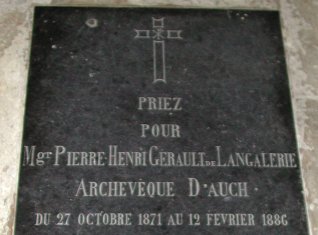 |
At the beginning of this article is an image of the Burial of Christ. It is found in Chapel 17 in Auch Cathedral which formerly was called the “royal chapel” and is also known as the chapel of the Trinity. It is on this site that the foundation stone of the cathedral was laid on July 4th, 1489. (I found this to be synchronous also since it was on July 4th that Ark first wrote to me from Florence where Leonardo da Vinci spent so much of his life.) It is also in the crypt directly under chapel 17 where the burial, or "sepulcher" stands, that another strange coincidence was noted. On my first visit (I'm now such a regular that the caretaker just gives me the key instead of taking me down himself), as I stood under the burial of Christ just looking around in an unfocused way to see if there was anything that caught my eye, I finally looked at the floor under my feet. There was a grave there, an Archbishop, and the dates of his appointment and death - one date at the toes of each of my feet - were my birthday and my husband's (Ark) birthday. The Cathedral was also dedicated on my birthday: February 12.
We discussed the strange date synchronicities with mathematician Robert Coquereaux (See The Cave Beneath the Sea) and he admitted that our more or less "random choice" for the area of our new home having a cathedral dedicated on my birthday, with the foundation stone laid on the anniversary of the date Ark first wrote to me, and then including a grave stone in the crypt above the foundation stone with both our birthdays on it was stretching "coincidence" a bit. But, being a true scientist, he proposed that we should have to do many "trials" to be "scientific" about drawing any conclusions.
Returning to the burial of Christ, which is in the chapel over the grave of Pierre-Henri Gerault de Langalerie, we find an excellent description of the piece in the writings of Raymond Montané:
The Burial assembles eight traditional characters together in a very unusual way. There is Jesus laid out on a cloth and, arranged behind him, Mary the mother of Jesus, two additional women, St. John the Apostle, and Mary Magdalene standing at Jesus’ feet with her alabaster jar. Joseph of Arimathea and Nicodemus hold the shroud at each end.
Each character in the tableau is identifiable by attitude, details of costume, position in relation to Jesus, or by the object in his or her hand. The woman standing next to Jesus’ mother is shown in a very special way: she actually occupies the central place of honor, and holds the crown of thorns - a “star,” perhaps? She is wearing the head covering of a married woman, and her place of honor depicts her as the wife of Jesus. But, this wife is not Mary Magdalene who is clearly positioned at the feet. Mary Magdalene is depicted in such a way that you cannot mistake who she is with her long hair on display and holding the alabaster jar. Her headdress, in fact, is that of an unmarried girl. In fact, if you look at Mary Magdalene up close, she looks more like a daughter of the family gathered about the body:
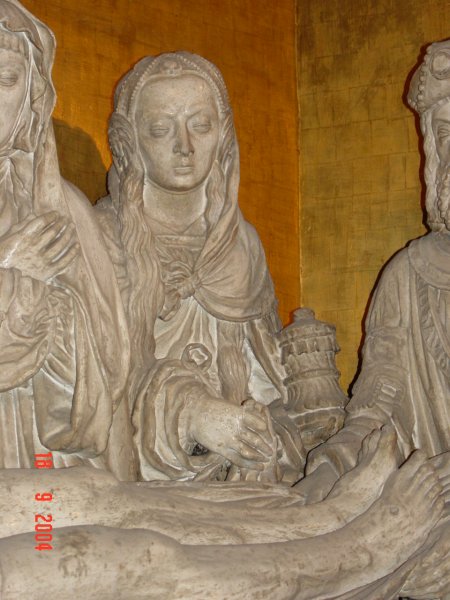 |
Father Raymond Montané tells us:
The canopy, of flamboyant style, is decorated with an original Trinity. It is the “showing” of Christ on the Cross, by God the Father himself. The Holy Spirit, symbolised by a dove, is placed between the Father and the Son. This theophany is truly in relation with the Burial of Christ, and even more with the theological basis of the Passion, but not with the text properly said to be of the Gospels.
He notes in passing that the monument was inspired by Margaret of Austria. Margaret’s husband, Philibert de Savoie was a cousin of one of the bishops that was involved in the commissioning of the work of the cathedral, Francois de Savoie, and this was the family in possession of the Shroud of Turin.
It is also noted in the history of Auch that Marguerite of Navarre, the second cousin of Margaret of Austria, was closely associated with Auch Cathedral. We will be delving further into the people associated with the Cathedral Ste-Marie at Auch in another book dedicated to its mysteries, but allow me to give the reader some clues.
Marguerite of Navarre takes us right back to Fulcanelli.
In the early 1520s, Marguerite became involved in the movement for the reform of the church, meeting and corresponding with the leading reformers of the period. In 1527, apparently by her own choice, (rare in those days) Marguerite married Henri d’Albret, King of Navarre (though most of his kingdom was in Spanish hands). Henri d’Albret was the son of Catherine de Foix, descended from a famous Cathar family.
Around 1531, Marguerite allowed a poem she had written to be published, Miroir de l'ame pecheresse (Mirror of the sinful soul). Marguerite gave a copy of Miroir to one of her ladies in waiting, Anne Boleyn, and it was later translated into English by Anne’s 12 year old daughter, Elizabeth later to become the greatest monarch England has ever known. As it happens, Anne Boleyn had previously been the lady in waiting to Margaret of Austria, so the two ladies undoubtedly communicated with one another and shared a Lady in Waiting. It also makes one wonder about the possibility that there was a great mystery surrounding Anne Boleyn?
A fascinating article entitled The Holbein Code has recently been published in Fortean Times (FT 202), written by David Hambling, a well respected journalist. He suggests that this particular painting by Holbein was intended to deliver a specific message. He writes:
There is no contemporary record of the painting, and the two sitters were not identified for centuries. In 1890, Sir Sidney Colvin suggested that the man on the left was Jean de Dinteville, French ambassador to the court of Henry VIII, because of the presence of Polisy, Dinteville's chateau, on the terrestrial globe visible in the painting. In 1900, Mary Hervey did some historical detective work, visiting Polisy and sifting through 17th century documents, including a 1653 inventory of possessions. She confirmed that the painting had originally hung there, and identified the second sitter as George de Selve, bishop of Lavour and sometime French ambassador to the Holy Roman Empire.
The picture, then, shows French ambassadors on a mission to London at a crucial point in history. Henry VIII was about to discard the Spanish Catherine of Aragon and declare Anne Boleyn his new queen. Anne had spent her formative years at the French court...
The driving force of the Renaissance was the new concept of Humanism, "the spirit of intellectual freedom by which man asserted his independence from the authority of the Church." In the mediaeval view, the Church could pronounce on everything, from the nature of God to the motion of the stars and the shape of the Earth. Humanism challenged the existing order.
There were new sources of information available from outside the Christian world: pagan Greek philosophers... Humanists tried to integrate all this into a single whole. A new spirit of inquiry was stirring. Copernicus had just published his theory that the Earth was not the centre of the Universe, and Martin Luther [nailed his 95 theses to the door of the church...]
The Church resisted, sometimes violently. Luther's proposed reforms were seen as heretical; so was Copernicus's theory. And anyone experimenting with Alchemy, Astrology, Cabalism or novel religious views learned to keep quiet or face burning.
We know Anne Boleyn supported the Evangelical cause. The writings of poet Nicholas Bourbon, who fled to England under her protection, give us an indiscreet glimpse of the group surrounding her. There were Thomas Cromwell and Thomas Cranmer, as well as Evangelical Bishop Hugh Latimer, Nicholas Kratzer, William Butts - and the painter Hans Holbein. [...]
The members of this small, close-knit cabal that engineered Anne Boleyn's rise had two things in common: they were self-made men rather than aristocrats, and they held views which could be dangerous. Hence, their actions to turn England down a new road and make it safe for those threatened by the established church kick-starting the Reformation in the process.
Dinteville was an ally of Anne Boleyn. He was a patron of the humanist Jacques Lefevre, and Mary Hervey notes that he was also rumoured to be an enthusiast for the "secret sciences" of alchemy and astrology. Holbein's painting might indicate religious sympathies...
The most detailed study of the painting has been carried out by Professor John North, emeritus professor of the History of Philosophy and the Exact Sciences at the University of Groningen in the Netherlands. His book, The Ambassadors' Secret, contains a wealth of detail... [David Hambling]
As it happens, the instruments depicted in the painting indicate an exact time and date: 4 p.m. on 11 April 1533. This date was Good Friday, the day and hour of the alleged death of Jesus IF he had actually been crucified 1,500 years earlier in AD 1.
North is not given to theorising without a solid base of evidence. Like others, he considers the possible influence of the great Renaissance magus Cornelius Agrippa of Nettesheim, a figure at the French court who may have been an acquaintance of Dinteville, Holbein or Kratzer, but he finds the sheer volume and complexity of symbolism used by Agrippa makes it impossible to be certain of correspondences. [...]
The Ambassadors is not just a portrait of two French dignitaries, but was intended as an instrument to - quite literally -change history. [David Hambling]
Here, I will give the "other side of the story" that may suggest an entirely different explanation for the "Holbein Code," and how it may very well mesh with the so-called "Da Vinci Code." What does seem to be true is that a desperate attempt was being made to transmit knowledge, to propagate Gnosis, but it failed when the headsman came to remove the head of Anne Boleyn because she could not produce a male heir for Henry.
But then, perhaps it did NOT fail after all? Perhaps it was just not yet time?
Getting back to Marguerite of Navarre, the mistress and teacher of Anne Boleyn, Sorbonne theologians condemned her poem, Miroir as heresy. A monk said Marguerite should be sewn into a sack and thrown into the river Seine, and students at the College of Navarre satirized her in a play as “a fury from Hell”. But her brother, Francis I, King of France, forced the dropping of the charge and an apology from the Sorbonne.
Marguerite was one of the most influential women in France. Her salon became famously known as the “New Parnassus”. The writer, Pierre Brantôme, said of her: “She was a great princess. But in addition to all that, she was very kind, gentle, gracious, charitable, a great dispenser of alms and friendly to all.”
The Dutch humanist, Erasmus, wrote to her: “For a long time I have cherished all the many excellent gifts that God bestowed upon you; prudence worth of a philosopher; chastity; moderation; piety; an invincible strength of soul, and a marvelous contempt for all the vanities of this world. Who could keep from admiring, in a great King's sister, such qualities as these, so rare even among the priests and monks?”
As a generous patron of the arts, Marguerite befriended and protected many artists and writers, among them François Rabelais.
Fulcanelli refers us frequently to Francois Rabelais. As it happens, his Gargantua-Pantagruel series, Le Tiers Livre des faicts et dicts héroïques du bon Pantagruel (1546), was dedicated to Marguerite of Navarre.
Another of Marguerite’s associates and correspondents was Jules Cesar Scaliger who was a close friend and associate of Nostradamus. Nostradamus, as mentioned, was born in Alet-le-Bains, in Foix lands - Cathar country. Nostradamus also attended school with Rabelais.
In 1525 Nostradamus settled in Agen, not far from Toulouse and Auch. In 1534, it is said he married a woman of “High Estate”, who gave him two children. This woman has never been identified, but considering his highly probable association with Marguerite of Navarre, it is likely that there was some connection there. It is said that, in 1538, his wife and children died of the plague. Around the same time, he had a falling out with Scaliger, and he was accused of heresy by the Inquisition because of a statement made in earlier years.
Nostradamus' biographers tell us that he left Agen and “wandered around Southern France.” It was only in 1546, two years before the consecration of Auch Cathedral, that Nostradamus settled in the village of Salon de Craux which has laid claim to his glory for all these many years. To sum up the mystery we find here, Nostradamus lived in Agen for 13 years, and there are 8 years that no one knows exactly where he was or what he was doing. It is quite likely that he took refuge with Marguerite of Navarre who was the patron and protector of such as Nostradamus. One wonders what influence Nostradamus may have had on the history depicted in Auch Cathedral?
Scaliger, we should note, is the “author” of the accepted historical chronology that is coming more and more into question in the present day. It is possible that the falling out between him and Nostradamus related, in part, to disagreements regarding how history should be viewed and taught.
In 1550, one year after Marguerite's death, a tributary poem, Annae, Margaritae, Ianae, sororum virginum heroidum Anglarum, in mortem Diuae Margaritae Valesiae, Nauarrorum Reginae, Hecatodistichon, (yes, long title!) was published in England. It was written by the nieces of Jane Seymour (1505-37), third wife of King Henry VIII. So, certainly, all these ladies were in contact with one another, and it is likely that secrets were shared among them.
Thus we see, in the person of Marguerite of Navarre, an individual who is central to the mystery of Auch Cathedral, whose associations suggest to us that she was well acquainted with esotericism and possibly even secrets passed down from the time of the Crusades against the Cathars - and more. Fulcanelli points us to Rabelais, and Rabelais leads us to Marguerite, and so we arrive at Auch Cathedral where the great mystery awaits the attentive seeker.
The next photograph is a close-up of the Burial of Christ said to have been inspired by Margaret of Austria, kinswoman of Marguerite of Navarre, showing the four women of the eight figures. Notice the headdresses of the four women. That of the woman in the position of wife is distinctively different from those of Mary, the mother, and the woman to the right of the "wife."
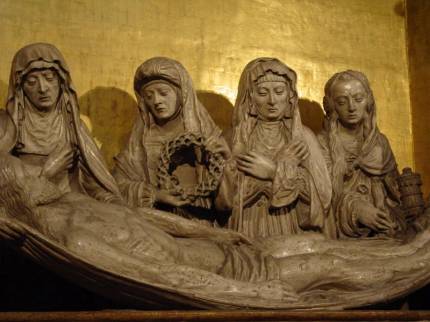 |
The image below is a close-up of the woman standing in the place of honor of the wife of the deceased, holding the crown of thorns. Next to her, you will see a sibyl from the windows of Arnaud de Moles holding a palm branch of Hope/fertility. Note carefully the spiral insignia over their breasts. Note also the unusual turban of the wife, identical to the turban of the Sibyl.
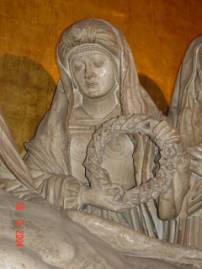 |
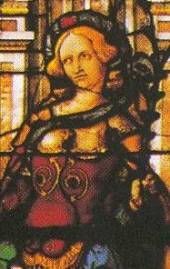 |
Now, let's take a look at one of the carvings in the Choir of Auch Cathedral that depicts the Gifts of the Magi to the Infant Christ. Notice, in particular, the hats of the "Three Kings." The one at far right still has his on, the one kneeling has laid his on the ground, and the one in the center of the tableau has lifted his in such a way that it seems it covered the chalice he holds in his other hand. Again, we note the similarity of the head coverings: turbans that are associated nowadays with the Arabs. We wonder what relationship the "wife" of Jesus had to the "Magi?"
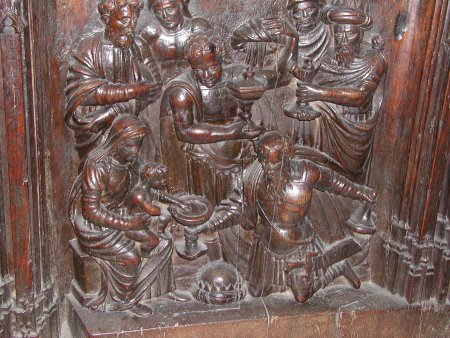 |
There are two other images I would like to show the reader because they are typical of the esoterica displayed in this marvelous Cathedral. Both of them represent a similar theme that will be easy to discern in imagery, but requires some interpretation to bring the symbol to understanding.
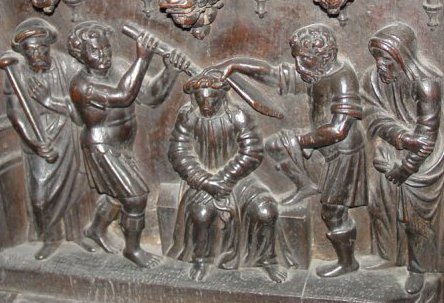 |
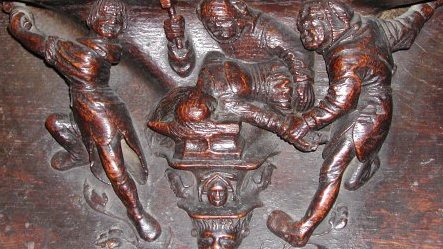 |
Now, what are these figures trying to tell us? In both images, something is being done to the head of the central figure. In the upper image, it looks as though the attendants are trying to dislodge something from the head of the seated man by force. In the second image, we see an individual being held down with his (or her) head placed on an anvil while the three associated figures are depicted as hammering the head!
Is this some terrible Medieval torture being depicted?
No, it is a depiction of INITIATION. And, in fact, in one of the windows of Arnaud de Moles, Jesus is depicted as the central figure in the image above: having something done to his head. The figure above may, in fact, be meant to indicate Jesus because the head is shown with a covering of some sort that could be the "crown of thorns."
A Shaman is, as Historian of Religion, Mircea Eliade describes, a Technician of Ecstasy. This is an essential qualification and/or result of contact with the Divine. More than that, in order to be in direct contact with the Divine, the human being must be able to "see the unseen." This Seeing is the capacity of human beings to enlarge their perceptual field until they are capable of assessing not only outer appearances, but also the essence of everything in order to access the level of being that enables them make choices that are capable of initiating a new causal series in the world. It has nothing at all to do with "hallucinations" or mechanical means of altering brain perceptions: it is a "soul" thing, so to say.
The word "shaman" comes to us through Russian from the Tungusic saman. The word is derived from the Pali samana, (Sanskrit sramana), through the Chinese sha-men (a transcription of the Pali word).
The word shaman, may be related to Sarman. According to John G. Bennett , Sarmoung or Sarman:
"The pronunciation is the same for either spelling and the word can be assigned to old Persian. It does, in fact, appear in some of the Pahlawi texts...
The word can be interpreted in three ways. It is the word for bee, which has always been a symbol of those who collect the precious 'honey' of traditional wisdom and preserve it for further generations.
A collection of legends, well known in Armenian and Syrian circles with the title of The Bees, was revised by Mar Salamon, a Nestorian Archimandrite in the thirteenth century. The Bees refers to a mysterious power transmitted from the time of Zoroaster and made manifest in the time of Christ."
"Man" in Persian means "the quality transmitted by heredity and hence a distinguished family or race. It can be the repository of an heirloom or tradition. The word sar means head, both literally and in the sense of principal or chief. The combination sarman would thus mean the chief repository of the tradition..."
"And still another possible meaning of the word sarman is... literally, those whose heads have been purified." [John G. Bennett, Gurdjieff: Making of A New World]
Those whose heads have been purified! What an interesting idea!
The central theme of Shamanism is the "ascent to the sky" and/or the "descent" to the underworld. In the former, the practitioner experiences Ecstasy, in the latter, he battles demons that threaten the well being of humanity. There are studies that suggest evidence of the earliest practices is in the cave paintings of Lascaux with the many representations of the bird, the tutelary spirits, and the ecstatic experience (ca. 25,000 B.C.). Animal skulls and bones found in the sites of the European Paleolithic period (before 50,000 - ca. 30,000 BC) have been interpreted as evidence of Shamanic practice.
The "ecstatic experience" is the primary phenomenon of Shamanism, and it is this ecstasy that can be seen as the act of merging with the celestial beings. And merging results in Forced Oscillation that changes Frequency. Continued interaction with Celestial beings is a form of Frequency Resonance Vibration.
January 14, 1995
Q: (L) We have some questions and the first one is: You have told us in the past that you are us in the future and that you are moving this way to merge with us.
A: Yes.
Q: (L) As we measure time, how far in the future are you us?
A: Indeterminate as you measure time. [...] What is "future," anyway?
Q: (L) The future is simultaneous events, just different locales in space/time, just a different focus of consciousness, is that correct?
A: Yes, so if that is true, why try to apply linear thinking here, you see, we are merging with you right now!
The idea that there was a time when man was directly in contact with the Celestial Beings is at the root of the myths of the Golden Age that have been redacted to the Grail stories of the 11th and 12th centuries. During this paradisical time, it is suggested that communications between heaven and earth were easy and accessible to everyone. Myths tell us of a time when the "gods withdrew" from mankind. As a result of some "happening," i.e. "The Fall," the communications were broken off and the Celestial Beings withdrew to the highest heavens.
But, the myths also tell us that there were still those certain people who were able to "ascend" and commune with the gods on the behalf of their tribe or family. Through them, contact was maintained with the "guiding spirits" of the group. The beliefs and practices of the present day shamans are a survival of a profoundly modified and even corrupted and degenerated remnant of this archaic technology of concrete communications between heaven and earth such as the Cassioopaean Transmissions.
The shaman, in his ability to achieve the ecstatic state inaccessible to the rest of mankind, due to the fusion of his emotional center via suffering, generally, (witness the metaphor of the Crucifixion), was regarded as a privileged being. More than this, the myths tell us of the First Shamans who were sent to earth by the Celestial Beings to DEFEND human beings against the "negative gods" who had taken over the rule of mankind. It was the task of the First Shamans to activate, in their own bodies, a sort of "transducer" of cosmic energy for the benefit of their tribe. This was expressed as the concept of the "world tree," which became the "axis" or the Pole of the World and later the "royal bloodlines."
It does seem to be true that there is a specific relationship between this function and certain "bloodlines." But, as with everything that has been provided to help mankind, this concept has been co-opted by the forces seeking to keep mankind in darkness and ignorance. The true and ancient bloodlines of the First Shamans have been obscured and hidden by the false trail of the invented genealogies of the Hebrew Old Testament supposedly leading to certain branches of present day European royal and/or noble families, which seek to establish a counterfeit "kingship" that has garnered a great deal of attention in recent times. I devote some attention to this subject in The Secret History of the World.
As we have already noted, BEFORE the Fall, every human being had access to communication with the higher densities via the "Maidens of the Wells" of ancient Celtic legend.
AFTER the Fall, it seems that a specific genetic variation was somatically induced by the incarnation of certain higher density beings who "gave their blood" for the "redemption of man." That is to say that they changed the body and DNA by Forced Oscillation. It is likely that this was done through the female incarnations because of the role of the mitochondrial DNA, but I don't want to get ahead of myself here, so we will leave that for the moment.
Nevertheless, the presence of this DNA, depending upon the terms of recombination, makes it very likely that there are many carriers of this bloodline/Shamanic ability on the earth today, though very few of them are carrying the "convergent" bloodlines.
The Sufis have kept the "Technician of Ecstasy" concept alive in their tradition of the "Poles of the World." The kutub or q'tub (pole of his time) is an appointed being, entirely spiritual of nature, who acts as a divine agent of a sphere at a certain period in time. Each kutub has under him four awtads (supports) and a number of abdals (substitutes) , who aid him in his work of preserving and maintaining the world. The interesting thing about this idea is that the individual who occupies the position does not even have to be aware of it! His life, his existence, even his very physiology, is a function of higher realities extruded into the realm of man. That this has a very great deal to do with "bloodlines," as promulgated in recent times is true, but not necessarily in the ways suggested.
In the present time, it seems that those with the "bloodline" are awakening. It is no longer feasible to be a "Pole of the World" who is asleep, because there are some very serious matters of choice and action that may be incumbent upon the awakened Shaman. The first order of business seems to be to awaken and accumulate strength of polarity.
Shamans are born AND made. That is to say, they are born to be made, but the making is their choice. And, from what I have been able to determine, the choice may be one that is made at a different level than the conscious, 3rd density linear experience. Those who have made the choice at the higher levels, and then have negated the choice at this level because they are not able to relinquish their ordinary life, pay a very high price, indeed.
A shaman stands out because of certain characteristics of "religious crisis." They are different from other people because of the intensity of their religious experiences. In ancient times, it was the task of the Shamanic elite to be the "Specialist of the Soul," to guard the soul of the tribe because only he could see the unseen and know the form and destiny of the Group Soul. But, before he acquired his ability, he was often an ordinary citizen, or even the offspring of a shaman with no seeming vocation (considering that the ability is reputed to be inherited, though not necessarily represented in each generation.)
At some point in his life, however, the shaman has an experience that separates him from the rest of humanity. The Native American "vision quest" is a survival of the archaic understanding of the natural initiation of the shaman who is "called" to his vocation by the gods.
A deep study of the matter reveals that those who seek the magico-religious powers via the vision quest when they have not been called spontaneously from within by their own questing nature and feeling of responsibility for humanity, generally become the Dark Shamans, or sorcerers; those who, through a systematic study, obtain the powers deliberately for their own advantage.
The true Shamanic initiation comes by dreams, ecstatic trances combined with extensive study and hard work: intentional suffering. A shaman is expected to not only pass through certain initiatory ordeals, but he/she must also be deeply educated in order to be able to fully evaluate the experiences and challenges that he/she will face. Unfortunately, until now, there have been precious few who have traveled the path of the Shaman, including the practice of the attendant skills of "battling demons," who could teach or advise a course of study for the Awakening Shaman. In my own case, over thirty years of study, twenty years of work as a hypnotherapist and exorcist, and the years of "calling to the universe" that constitute the Cassiopaean Experiment stand as an example of how the process might manifest in the present day.
The future shaman is traditionally thought to exhibit certain exceptional traits from childhood. He is often very nervous and even sickly in some ways. (In some cultures, epilepsy is considered a "mark" of the shaman, though this is a later corrupt perception of the ecstatic state.) It has been noted that shamans, as children, are often morbidly sensitive, have weak hearts, disordered digestion, and are subject to vertigo. There are those who would consider such symptoms to be incipient mental illness, but the fact is that extensive studies have shown that the so-called hallucinations or visions consist of elements that follow a particular model that is consistent from culture to culture, from age to age, and is composed of an amazingly rich theoretical content. It could even be said that persons who "go mad," are "failed shamans" who have failed either because of a flaw in the transmission of the genetics, or because of environmental factors. At the same time, there are many more myths of failed Shamanic heroes than of successful ones, so the warnings of what can happen have long been in place. Mircea Eliade remarks that:
"... The mentally ill patient proves to be an unsuccessful mystic or, better, the caricature of a mystic. His experience is without religious content, even if it appears to resemble a religious experience, just as an act of autoeroticism arrives at the same physiological result as a sexual act properly speaking (seminal emission), yet at the same time is but a caricature of the latter because it is without the concrete presence of the partner."
Well, that's a pretty interesting analogy! It even suggests to us the idea that one who attempts to activate a Shamanic inheritance within the STS framework of Wishful Thinking, has an "illusory" partner as in the above-described activity, with similar results. In other words, Sorcery is like masturbation: the practitioner satisfies himself, but his act does no one else any good. And, by the same token, a Shaman who operates without knowledge is like the proverbial "three minute egg": he gets everybody all excited, and then leaves them hanging! In both cases, such an individual has satisfied only themselves, and it could be said that, in the latter case, it is actually worse because another individual has been used for that satisfaction.
But, such amusing vulgarities aside (even if they DO make the point remarkably well) the thing about the shaman is that he/she is not just a sick person, he is a sick person who has been CURED, or who has succeeded in curing himself, at least spiritually!! The possibility of achieving the Shamanic powers for Service to Self also exists, so great care has to be used in trying to "see the unseen."
In many cases, the "election" of the shaman manifests through a fairly serious illness which can only be cured by the "ascent to the sky." After the ecstatic vision of initiation, the shaman feels MUCH better! After the response to the calling of the gods, the shaman shows a more than normally healthy constitution; they are able to achieve immense concentration beyond the capacity of ordinary men; they can sustain exhausting efforts and, most importantly, they are able to "keep a cool head" in the face of experiences that would terrify and break an ordinary person.
Another point that should be emphasized is that the Shaman must be able to be in full control of himself even when in the ecstatic state! (Trance channeling with no memory of what transpired is NOT the activity of a Shaman!) This ability to "walk in two worlds simultaneously" demonstrates an extraordinary nervous constitution. It has been said that the Siberian shamans show no sign of mental disintegration well into old age; their memories and powers of self-control are WELL above average.
Castaneda's Don Juan calls this state being "impeccable." This idea is also reflected in the archaic systems of the Yakut, where the shaman must be "serious, possess tact, be able to communicate effectively with all people; above all, he must not be presumptuous, proud, ill-tempered." The true shaman emanates an inner force that is conscious, yet never offensive. At the same time, it should be noted that a true shaman might evoke very negative responses from those who are under the domination of the Entropic forces. I have certainly experienced this more times than I care to mention.
Getting back to the infirmities, nervous disorders, illness of crisis and so forth that are the "signs of election," it is also noted that, sometimes an accident, a fall, a blow on the head, or being hit by lightning are the signs from the environment that the shaman has been elected. But, being "called" is not the same as being "chosen," or, more precisely, choosing. "Many are called; few choose to respond."
This choosing is a process, and it is a process of struggle and pain and suffering because, in the end, what is being killed is the ego.
The pathology of the Shamanic path seems to be part of the means of reaching the "condition" to be initiated. But, at the same time, they are often the means of the initiation itself. They have a physiological effect that amounts to a transformation of the ordinary individual into a technician of the sacred.
(But, if such an experience is not followed by a period of theoretical and practical instruction, the shaman becomes a tool for those forces that would use the Shamanic function to further enslave mankind as we have already noted.)
Now, the experience that transforms the shaman is constituted of the well-known religious elements of suffering, death and resurrection. One of the earliest representations of these elements is in the Sumerian story of the descent of Ishtar/Inanna into the Underworld to save her son-lover, Tammuz. She had to pass through Seven "gates of Hell" and, at each door or gate, she was stripped of another article of her attire because she could only enter the Underworld Naked. While she was in the underworld, the earth and its inhabitants suffered loss of creative vigor. After she had accomplished her mission, fertility was restored.
The most well known variation of this story is the myth of Persephone/Kore, the daughter of Demeter, who was kidnapped by Hades/Pluto.
The Shamanic visions represent the descent as dismemberment of the body, flaying of the flesh from the bones, being boiled in a cauldron, and then being reassembled by the gods and/or goddesses. This, too, is well represented in myth and legend, including the myth of Jesus: Suffering, death, and resurrection. In short, the crucifixion - the Burial of Christ - is a symbol of the Shamanic Transformation:
A Yakut shaman, Sofron Zateyev, states that during this visionary initiation, the future shaman "dies" and lies in the yurt for three days without eating or drinking. ...
Pyotr Ivanov gives further details. In the vision, the candidate's limbs are removed and disjointed with an iron hook; the bones are cleaned, the flesh scraped, the body fluids thrown away, and the eyes torn from their sockets. After this operation all the bones are gathered up and fastened together with iron.
According to a third shaman, Timofei Romanov, the visionary dismemberment lasts from three to seven days; during all that time the candidate remains like a dead man, scarcely breathing, in a solitary place. [Eliade, 1964]
According to another Yakut account, the evil spirits carry the future shaman's soul to the underworld and there shut it up in a house for three years (only one year for those who will become lesser shamans). Here the shaman undergoes his initiation. The spirits cut off his head, which they set aside (for the candidate must watch his dismemberment with his own eyes), and cut him into small pieces, which are then distributed to the spirits of the various diseases. Only by undergoing such an ordeal will the future shaman gain the power to cure. His bones are then covered with new flesh, and in some cases he is also given new blood.
According to another account, the "devils" keep the candidate's soul until he has learned all of their wisdom. During all this time the candidate lies sick. There is also a recurring motif of a giant bird that "hatches shamans" in the branches of the World Tree which is an allusion to an "Avian bloodline" that is opposed to a Reptilian heritage. The following excerpts are from the available accounts obtained in field research and should be read with the awareness that we have now entered a world of pure symbolism:
"...The candidate ...came upon a naked man working a bellows. On the fire was a caldron "as big as half the earth." The naked man saw him and caught him with a huge pair of tongs. The novice had time to think, "I am dead!" The man cut off his head, chopped his body into bits, and put everything in the caldron. There he boiled his body for three years.
There were also three anvils, and the naked man forged the candidate's head on the third, which was the one on which the best shamans were forged. ...
The blacksmith then fished the candidate's bones out of a river in which they were floating, put them together, and covered them with flesh again. ...
He forged his head and taught him how to read the letters that are inside it. He changed his eyes; and that is why, when he shamanizes, he does not see with his bodily eyes but with his mystical eyes. He pierced his ears, making him able to understand the language of plants.
…The Tungus shaman Ivan Cholko states that a future shaman must fall ill and have his body cut in pieces and his blood drunk by the evil spirits. These throw his head into a caldron where it is melted with certain metal pieces that will later form part of his ritual costume.
...Before becoming a shaman the candidate must be sick for a long time; the souls of his shaman ancestors then surround him, torture him, strike him, cut his body with knives, and so on. During this operation the future shaman remains inanimate; his face and hands are blue, his heart scarcely beats.
...A Teleut woman became a shamaness after having a vision in which unknown men cut her body to bits and cooked it in a pot. According to the traditions of the Altain shamans, the spirits of their ancestors eat their flesh, drink their blood, open their bellies and so on.
...In South America as in Australia or Siberia both spontaneous vocation and the quest for initiation involve either a mysterious illness or a more or less symbolic ritual of mystical death, sometimes suggested by a dismemberment of the body and renewal of the organs.
...They cut his head open, take out his brains, wash and restore them, to give him a clear mind to penetrate into the mysteries of evil spirits, and the intricacies of disease; they insert gold dust into his eyes to give him keenness and strength of sight powerful enough to see the soul wherever it may have wandered; they plant barbed hooks on the tips of his fingers to enable him to seize the soul and hold it fast; and lastly they pierce his heart with an arrow to make him tenderhearted, and full of sympathy with the sick and suffering.
...If the alleged reason for the renewal of the organs (conferring better sight, tenderheartedness, etc.) is authentic, it indicates that the original meaning of the rite has been forgotten.
...Then the master obtains the disciple's "lighting" or "enlightenment," for [this] consists of a mysterious light which the shaman suddenly feels in his body, inside his head, within the brain, an inexplicable searchlight, a luminous fire, which enables him to see in the dark, both literally and metaphorically speaking, for he can now, even with closed eyes, see through darkness and perceive things and coming events which are hidden from others...
The candidate obtains this mystical light after long hours of waiting, sitting on a bench in his hut... When he experiences it for the first time "it is as if the house in which he is suddenly rises; he sees far ahead of him, through mountains, exactly as if the earth were one great plain, and his eyes could reach to the end of the earth. Nothing is hidden from him any longer; not only can he see things far, far away, but he can also discover souls, stolen souls, which are either kept concealed in far, strange lands or have been taken up or down to the Land of the Dead.
...The experience of inner light that determines the career of the Iglulik shaman is familiar to a number of higher mysticisms. In the Upanishads, the "inner light" defines the essence of the atman. In yogic techniques, especially those of the Buddhist schools, light of different colors indicates the success of particular meditations. Similarly, the Tibetan Book of the Dead accords great importance to the light in which, it appears, the dying man's soul is bathed during his mortal throes and immediately after death; a man's destiny after death (deliverance or reincarnation) depends on the firmness with which he chooses the immaculate light.
...The essential elements of this mystical vision are the being divested of flesh. ...In all these cases reduction to the skeleton indicates a passing beyond the profane human condition and, hence, a deliverance from it.
...Bone represents the very source of life. To reduce oneself to the skeleton condition is equivalent to reentering the womb for a complete renewal, a mystical rebirth. ...It is an expression of the will to transcend the profane, individual condition, and to attain a transtemporal perspective.
...The myth of renewal by fire, cooking, or dismemberment has continued to haunt men even outside the spiritual horizon of shamanism. ...
The myth of rejuvenation by dismemberment and cooking has been handed down in Siberian, Central Asian, and European folklore, the role of the blacksmith being played by Jesus or other saints. [Eliade, Shamanism, 1964]
The reader may now have a better idea of what the strange images of work being done on the initiate's head, including the hammering of the head on an anvil, must mean: the Shamanic Initiation, the Alchemical Transmutation via Techniques of Ecstasy. We now better understand what Fulcanelli was trying to tell us:
The strongest impression of my early childhood - I was seven years old - an impression of which I still retain a vivid memory, was the emotion aroused in my young heart by the sight of a gothic cathedral. I was immediately enraptured by it. I was in an ecstasy, struck with wonder, unable to tear myself away from the attraction of the marvellous, from the magic of such splendour, such immensity, such intoxication expressed by this more divine than human work.
These same ideas of death and re-birth are well represented in Alchemical literature as the various processes of "chemical transmutation." As we have quoted already:
In order to respect the principle of hermetism adopted by the Tradition, we must understand that esoteric teachings are given in a sibylline form.
St Isaac the Syrian points out that: The Holy Scriptures say many things by using words in a different sense from their original meaning. Sometimes bodily attributes are applied to the soul, and conversely, attributes of the soul are applied to the body. The Scriptures do not make any distinction here. However, enlightened men understand.
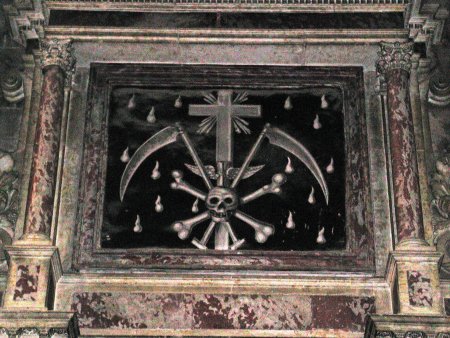 |
We also now have a better understanding of the ancient image of the skull and crossbones surrounded by little tongues of fire that is prominently displayed in Auch Cathedral.
Years ago I read the story promoted in the book Holy Blood, Holy Grail, that Jesus had a wife and that she was Mary Magdalene. I immediately consulted with friends in France who live in Marseille about this so-called “well-known” legend. What I learned is that yes, it was said that Mary Magdalene came to France accompanied by other individuals. She was closely associated with St. Maximin, but never, until the raft of books following Holy Blood, Holy Grail, was she thought to have been the wife of Jesus.
Clearly, in 1548, and much, much earlier, it was known that Jesus had a wife as is depicted in the statues of Auch Cathedral, but it clearly wasn’t Mary Magdalene. We cannot even be certain that the depiction of a "wife" means that literally, that it does not indicate to us a process rather than an actual state of physical marriage.
So, the question is: who was the wife of Jesus and does this depiction suggests a "physical" wife, or does it depict an Initiatory process?
I will deal with that question in a future volume, but for now, let me share with the reader additional clues.
We come now to the intriguing link between Marguerite of Navarre and Leonardo da Vinci who died in 1519 while he was a guest of Marguerite and her brother Francis. A Venetian ambassador of the time praised Marguerite as "knowing all the secrets of diplomatic art," and thus, a person to be treated with deference and circumspection. We see here a definite clue since Fulcanelli repeatedly referred to the Green Language as "The Language of Diplomacy."
By 1508, Leonardo's career was drawing to a close though it would yet be ten years before his death. Only two paintings survive from that period; the Louvre's Virgin and Child with St. Anne and St. John.
Leonardo had made Milan, ruled by the French, his home for some time. In 1512, an alliance of Swiss, Spaniards, Venetians and papal forces drove the French out of Milan which was a minor issue of history for France, but a major disaster for Leonardo. He was about 60 years old and had been treated by the French with understanding and compassion. Now, he suddenly found himself without patronage or income, verging on total poverty. His fame had faded and, while the new rulers of Milan were not openly hostile toward him, he was certainly not accorded any honor or comfort.
In February of 1513, Pope Julius II died and was succeeded by Leo X - made famous by saying "It has served us well, this myth of Christ" - a Medici. The Medici had never shown Leonardo any special favor, but he apparently decided to throw himself on their mercy since they were, after all, patrons of the arts.
In September of 1513, the aging Leonardo set off for Rome. Pope Leo X was persuaded to give Leonardo a small commission - subject unknown - but the result was a disaster. When Leonardo started the project by compounding a special preservative varnixh, the Pope reportedly threw up his hands saying "This man will never accomplish anything! He thinks about the end before the beginning!" Leonardo's notebooks record, around this time: "We should not desire the impossible." and "Tell me if anything was ever done..."
Not surprisingly, Leonardo became ill. The nature of his illness is unknown, but it is thought from other clues that he suffered a mild stroke affecting his right side. (He was left handed, fortunately.) Leonardo's self-portrait was apparently made during this time. His last painting was completed in Rome, noted to have been done without commission, but due to some inner compulsion. It is in the Louvre: St John.
Sick and forgotten in Rome, the French did not forget Leonardo. Francis I, brother of Marguerite of Navarre, offered Leonardo a manor house in France near the royal chateau of Amboise, and any funds he might require for his needs, wants, and any project he might, on his own, wish to undertake. Francis only wished the pleasure of Leonardo's company.
Leonardo set off for France taking with him his notes, his drawings, his last two paintings: The St. John, The Virgin and Child with St. Anne, and a portrait described as "a certain Florentine Lady."
When Leonardo arrived at the royal castle at Amboise, he was given the title: "Premier peinctre et ingenieur et architecte du Roy" not for anything he was expected to do, but for what he had done already. Francis always went to see Leonardo, taking the view that it was easier for a vigorous 22 year-old king to make a call on an aging artist than vice versa.
Leonardo must have made quite an impression on Francis because, 24 years later, Benvenuto Cellini, then in the French service also, wrote:
King Francis being violently enamored of his great talents took so great a pleasure in hearing him discourse that there were few days in the year when he was separated from him... He said that he did not believe that there had ever been another man born into the world who had known as much as Leonardo, and this not only matters concerning sculpture, Painting and ARchitecture, but because he was a great Philosopher.
It was in 1517, while Leonardo was at Amboise, that Martin Luther nailed his 95 theses to the door of the church at Wittenberg. Most of his activities in France are unknown. He died on May 2, 1519.
Vasari, Leonardo's biographer, raised a smoke screen around Leonardo's religious beliefs (or lack of them). In the first edition of his "Lives of the Painters," published in 1550, he wrote that "Leonardo was of such a heretical frame of mind that he did not adhere to any kind of religion, believing that it is perhaps better to be a philosopher than a Christian." In the second edition (1568), he omitted the sentence, writing instead: "He desired to occupy himself with the truths of the Catholic faith and the holy Christian religion. Then, having confessed and shown his penitence with much lamentation, he devoutly took the Sacrament."
Leonardo himself had written about Christian funerals: "Of the dead who are taken to be buried: The simple folk will carry a great number of lights to illuminate the journeys of all those who have wholly lost the power of sight. O human folly! O madness of mankind!"
But it seems that Leonardo was not an athiest either. The name of the Creator appears often enough in his writings and indicates that he had an extraordinary conception of a divine power. Certainly, if he had wished to be explicit about it in words, he was quite capable. But he didn't explain - except perhaps, in his art. Before his death he wrote:
"See: one's hopes and wishes to return to one's homeland and origin - they are just as moths trying to reach the light. And the man who is looking forward with joyful curiosity to the new spring, and the new summer, and always new months and new years - and even if the time he is longing forver comes, it will always seem to him to be too late - he does not notice that his longing carries within it the germs of his own death.
"But this longing is the quintessence, the spirit of the elements, which through the soul is enclosed in the human body and which craves for return to its source. You must know that this very yearning is the quintessence of life, the handmaid of Nature, and that Man is a model of the world."
As he aged, Leonardo's dark view of mankind and his general pessimism grew. He was reported to erupt into fury liberally laced with scatological phrases such as the diatribe about man penned by Jonathan Swift: "Men who can call themselves nothing more than a passage for food, producers of dung, fillers up of privies, for of them nothing else appears in the world, nor is there any virtue in them, for nothing of them remains but full privies."
Francis I had such great respect for Leonardo that he required nothing of him at all - he just wanted to be able to drop in as often as possible and talk to the Master. It was in France, an "alien land," that Leonardo gave his final trumpet blast in an apocalyptic series of drawings called "The Deluge" which he predicted would one day inundate the earth and end the world of Man.
These drawings, almost abstract in their abandonment of traditional artistic styles, were obviously vivid exercises of his imagination. His scientific knowledge is applied here with devastating effect, showing how puny are the means of man when pitted against nature.
"Ah, what dreadful tumults one heard resounding through the gloomy air!" he wrote in the commentary to these drawings; "Ah me, how many lamentations!"
His depictions of the deluge were terrifying:
"Let the dark, gloomy air be seen beaten by the rush of opposing winds wreathed in perpetual rain mingled with hail... All around let there be seen ancient trees uprooted and torn in pieces by the fury of the winds... And let the fragments of some of the mountains be fallen down into the depths of one of the valleys, and there form a barrier to the swollen waters of its rivers, which having already burst the barrier rushes on with immense waves..."
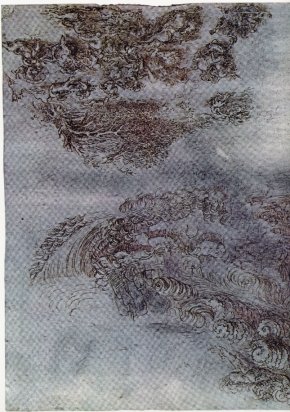 |
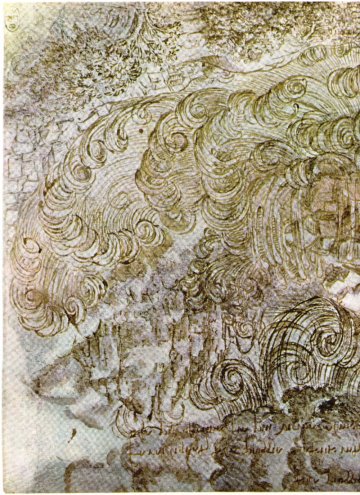 |
This was Leonardo's Last Judgment on the World, his last message to mankind. Strange that it is the message of Auch Cathedral, the message of Fulcanelli, Kardec, Nostradamus, etc. And strange that they are all tied together via their connections to Marguerite of Navarre -
Recall that the burial scene of Christ in Auch Cathedral was inspired by Margaret of Austria, who married into the family that was in possession of the Shroud of Turin. Margaret’s husband, Philibert de Savoie was a cousin of one of the bishops that was involved in the commissioning of the work of the cathedral, Francois de Savoie, and that Marguerite of Navarre, the second cousin of Margaret of Austria, was closely associated with Auch Cathedral.
Remember: Marguerite of Navarre takes us right back to Fulcanelli via François Rabelais whose series, Le Tiers Livre des faicts et dicts héroïques du bon Pantagruel (1546), was dedicated to her.
It was after the death of Leonardo that Marguerite became involved in the movement for the reform of the church, meeting and corresponding with the leading reformers of the period. In 1527, apparently by her own choice, (rare in those days) Marguerite married Henri d’Albret, King of Navarre (though most of his kingdom was in Spanish hands). Henri d’Albret was the son of Catherine de Foix, descended from a famous Cathar family.
Recall also that another of Marguerite’s associates and correspondents was Jules Cesar Scaliger who was a close friend and associate of Nostradamus, that Nostradamus, as mentioned, was born in Alet-le-Bains, in Foix lands, and that Nostradamus also attended school with Rabelais.
Recall: It was around 1531, Marguerite allowed a poem she had written to be published, Miroir de l'ame pecheresse (Mirror of the sinful soul). Marguerite gave a copy of Miroir to one of her ladies in waiting, Anne Boleyn, and it was later translated into English by Anne’s 12 year old daughter, Elizabeth I. Recall as well that Anne Boleyn had previously been the lady in waiting to Margaret of Austria before she went to serve Marguerite of Navarre.
The connections are just simply too much to ignore, too much to consider "coincidence," in my opinion. And so it is that I believe it is only in the brief context I have been able to present here (more fully explicated in Secret History of the World), that we can truly come to some understanding of the REAL "Da Vinci Code."
After his death, Leonardo left his notebooks and manuscripts to his companion, Francesco Melzi. He took them all to his home near Milan where he guarded that "as though they were religious relics." Until Melzi's death, they were in safe hands. On his death, he left them to his son, a lawyer, trusting that he would honor them as well. Apparently not. The progress of dispersal began and the manuscripts and unbound sheets were sold, stolen, given away, and scattered over half the planet. In more recent years, attempts have been made to assemble at least facsimiles, but no one knows how much was lost. In the late 19th century, a great number of pages in the posession of the British Crown somehow disappeared and the guess is that they were hidden, not destroyed. One has to, of course, wonder why?
In any event, as mentioned, there are portions of his notebooks that have been collected together and a close study of his available writings give us many clues as to what he wished to "speak" about in his art. For example:
The mind of the painter must resemble a mirror, which always takes the colour of the object it reflects and is completely occupied by the images of as many objects as are in front of it. Therefore you must know, Oh Painter! that you cannot be a good one if you are not the universal master of representing by your art every kind of form produced by nature. And this you will not know how to do if you do not see thyem, and retain them in your mind.
We know very well that errors are better recognised in the works of others than in our own; and that often, while reproving little faults in others, you may ignore great ones in yourself. To avoid such ignorance in the first place make yourself a master of perspective, then acquire perfect knowledge of the proportions of men and other animals, and also, study good architecture that is so far as concenrs the forms of buildings and other objects which are on the face of the earth; these forms are infinite and the better you know them the more admirable will your work be.
The universal practice which painters adopt on the walls of chapels is greatly and reasonably to be condemned. Inasmuch as they represent on historical subject on one level with a landscape and buildings, and then go up a step and paint another, varying the point [of sight], and then a third and a fourth, in such a way as that on one wall there are 4 points of sight, which is supreme folly in such painters. We know that the point of sight is opposite the eye of the spectator of the scene; and if you would [have me] tell you how to represent the life of a saint divided into several pictures on one and the same wall, I answer that you must set out the foreground with its point of sight on a level with the eye of the spectator of the scene, and upon this plane represent the more important part of the story large and then, diminishing by degrees the figures, and the buildings on various hills and open spaces, and can represent all the events of the history. And on the remainder of the wall up to the top, put trees, large as compared with the figures, or angels if they are appropriate to the story, or birds or clouds or similar objects; otherwise do not trouble yourself with it for your whole work will be wrong.
When you have well learnt perspective and have by heart the parts and forms of objects, you must go about, and constantly, as you go, observe, note and consider the circumstances and behaviour of men in talking, quarrelling or laughing or fighting together: the action of the men themselves and the actions of the bystanders, who separate them or who look on.
When you compose a historical picture take two points, one the point of sight, and the other the source of light; and make this as distant as possible.
Historical pictures ought not to be crowded and confused with too many figures.
Of composing historical pictures. Of not considering the limbs in the figures in historical pictures; as many do who, in the wish to represent the whole of a figure, spoil their compositions. And when you place one figure behind another take care to draw the whole of it so that the limbs which come in front of the nearer figures may stand out in their natural size and place.
The figure is most admirable which by its actions best expresses the passion that animates it.
You must show a man in despair with a knife, having already torn open his garments, and with one hand tearing open the wound...
A picture or representation of human figures, ought to be done in such a way as that the spectator may easily recognise, by means of their attitudes, the purpose in their minds. Thus, if you have to represent a man of noble character in the act of speaking, let his gestures be such as naturally accompany good words; and, in the same way, if you wish to depict a man of a brutal nature, give him fierce movements; as with his arms flung out towards the listener, and his head and breast thrust forward beyond his feet, as if following the speaker's hands.
Thus it is with a deaf and dumb person who, when he sees two men in conversation - although he is deprived of hearing - can nevertheless understand from the attitudes and gestures of the speakers, the nature of their discussion.
When you wish to represent a man speaking to a number of people, consider the matter of which he has to treat and adapt his action to the subject. Thus, if he speaks persuasively, let his action be appropriate to it. If the matter in hand be to set forth an argument, let the speaker, with the fingers of the right hand hold one finger of the left hand, having the two smaller ones closed; and his face alert, and turned towards the people with mouth a little open, to look as though he spoke. And if he is sitting, let him appear as though about to rise, with his head forward. If you represent him standing make him leaning slightly forward with head towards the people. These you must represent as silent and attentive, all looking at the orator's face with gestures of admiration; and make some old men in astonishment at the things they hear, with the corners of their mouths pulled down and drawn in, their cheeks full of furrows, and their eyebrows raised...
The motions of men must be such as suggest their dignity or their baseness.
Make your work carry out your purpose and meaning. That is when you draw a figure consider well who it is and what you wish it to be doing.
The limbs which are used for labour must be muscular and those which are not much used you must make without muscles and softly rounded. Represent your figures in such action as may be fitted to express what purpose is in the mind of each; otherwise your art will not be admirable.
Fame should be depicted as covered all over with tongues instead of feathers, and in the figure of a bird.
Pleasure and Pain represent as twins, since there never is one without the other; and as if they were united back to back, since they are contrary to each other.
This represents Pleasure together with Pain, and show them as twins because one is never apart from the other. They are back to back because they are opposed to each other; and they exist as contrairies in the same body, because they have the same basis, inasmuch as the origin of pleasure is labour and pain, and the various forms of evil pleasure are the origin of pain. Therefore it is here represented with a reed in his right hand which is useless and without strength, and the wounds it inflicts are poisoned. In Tuscany they are put to support beds, to signify that it is here that vain dreams come, and here a great part of life is consumed. It is here that much precious time is wasted, that is, in the morning, when the mind is composed and rested, and the body is made fit to begin new labours; there again many vain pleasures are enjoyed; both by the mind in imagining impossible things, and by the body in taking those pleasures that are often the cause of the failing of life. And for these reasons the reed is held as their support. Evil-thinking is Envy or Ingratitude.
Envy must be represented with a contemptuous motion of the hand towards heaven, because if she could she would use her strength against God; make her with her face covered by a mask of fair seeming; show her as wounded in the eye by a palm branch and by an olive-branch, and wounded in the ear by laurel and myrtle, to signify that victory and truth are odious to her.
[Leonardo's quotes from: "The Notebooks of Leonardo Da Vinci" compiled and edited from the original manuscripts by Jean Paul Richter, Dover Edition, 1970, first published in 1883 by Sampson Low, Marston, Searle & Rivington under the title "The Literary Works of Leonardo da Vinci. Dover Publications, New York]
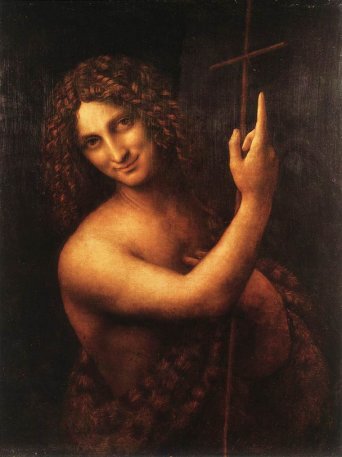
|
|
St. John. Louvre. It is said to be the most disquieting of Leonardo's work. Leonardo has transformed John, the alleged precursor of Christ, from a gaunt ascetic to what can only be said to be almost a hermaprhodite with soft, womanly flesh, glancing out of the painting with a look that is not renunciation, but sly mystery and devious invitation with finger pointing heavenward. From Leonardo's notebooks: "The limbs which are used for labour must be muscular and those which are not much used you must make without muscles and softly rounded. Represent your figures in such action as may be fitted to express what purpose is in the mind of each; otherwise your art will not be admirable." "Therefore it is here represented with a reed in his right hand which is useless and without strength, and the wounds it inflicts are poisoned. [...] And for these reasons the reed is held as their support. Evil-thinking is Envy or Ingratitude." "Envy must be represented with a contemptuous motion of the hand towards heaven, because if she could she would use her strengthe against God..." What, exactly, was Leonardo trying to tell us about St. John? |
It is thus strongly suggested that, in every painting he ever executed, Leonardo da Vinci was conveying messages. Not only that, the messages were somewhat codified. We can extract general principles from his writings and utilize them in examining his works.
As time passed after the death of Leonardo, critics began to come forward declaiming loudly that, "after all, Leonardo was only a man and his paintings, like those of other artists, consisted simply of colors applied to a surface. This was John Ruskin's general opinion paraphrased, and he made it clear that he thought the Master was greatly overrated. Renoir said: "Leonardo da Vinci bores me."
The most dramatic attacks on Leonardo's image came via Sigmund Freud. Working with what he mistakenly thought were historical facts, he produced an essay "Leonardo da Vinci, and a Memory of His Childhood." He suggested that Leonardo, lacking a father in the first years of his life, had abnormally erotic relations with his mother and later, when his father brought him into his household, that his stepmother was "too affectionate," perhaps even erotically so.
Freud's biggest blunder, however, was the emphasis he placed on a childhood dream of fantasy recorded by the artist himself of a large bird alighting on his shoulder. Freud coupled this with a remark made by Leonardo, to wit: "The act of procreation and everything that has any relation to it is so disgusting that human beings would soon die out if there were no pretty faces and sensuous dispositions," and concluded that Leonardo was a latent homosexual. That smear has stuck pretty well though there is absolutely NO evidence that it is true.
Freud placed his reliance on a largely fictional work by Dimitri Merejkowski, "The Romance of Leonardo da Vinci," which included the passage by Leonardo about the bird encounter. Unfortunately, the word had been rendered "vulture" which sent Freud off into raptures of humorless psychoanalysis based on ancient Egyptian mythology and sexual-religious beliefs concerning the vulture-headed goddess named Mut. Freud solemnly declaimed: "We may question whether the sound similarity to our word "mother" is only coincidental?"
The actual word that Leonardo used in describing his dream/fantasy was "kite," a bird of the hawk family common in Europe. In short, Freud's dissertation on Leonardo was irrelevant. But then, in my opinion, Freud himself is irrelevant.
Nevertheless, the word "kite" caught my attention. Here's why:
June 20, 1998
Q: ... Okay, let me ask this, these guys who have researched this Holy Bloodline business have sort of focused all the attention on a particular line, purportedly the line of Jesus going into the Merovingian kings... This guy, Pierre Plantard, seems to have more or less created a geneology with their own validations... sort of like describing x in terms of y and y in terms of x. Now, is this Pierre Plantard a genuine carrier of the bloodline that we are concerned with?
A: Partially.
Q: Then, that makes me think that the significant thing that we are looking for is a convergence of the blood lines... These lines are symbolized by the god figures, the children of Odin, and what we are looking for is a place where these lines converge?
A: Yes.
Q: Well, what characteristics might an individual have who is a product of this convergence?
A: Fair skinned and cleft chin.
Q: Well, Ark and F*** both have cleft chins, but C** and I don't! Does this mean...
A: We aren't saying that all with these features are of that blood line!
Q: So, you can have the bloodline and look quite different?
A: Yes.
Q: How many persons on the planet contain these 'convergant' bloodlines?
A: 7367. Kites were used for cross communication between bloodline members.
Q: Kites?! What do kites have to do with it? What the heck... you guys are driving me NUTS! Do you mean kites as in paper and string or kites as in the bird?
A: Yes, paper wood and string.
Q: ... (C) This is implying that such people know they have the bloodline and keep in touch with each other? (L) Or, is this something for the future when those of the bloodline wake up?
A: Yes. [to the] Latter.
Q: So, we need to go fly a kite... (C) With a particular shape and symbol...
A: Research kites.
Q: (C) The Japanese fly kites... and there are a lot of people who hang banners outside their houses all the time...
A: Want revelations? Prepare for "Treasure" Hunt.
Q: Thanks a lot!
A: These quests energize you, Laura!
Q: Yes, they do. When I start finding things that connect, it is like having little explosions of energy in the brain... (A) Well, I don't understand these kites. They don't fly by themselves, they are on a string. You cannot see them at great distances... only a few miles... what is the point of communicating this way with someone who is only a few miles away?
A: Kites can be released, or left behind too!
Q: (A) When you release a kite, it falls down! Well, maybe we ought to wait and see where this clue goes before we get stuck on the technical aspects. Maybe it is just sort of a marker... We don't know if it will relate to a literal kite, or a reference to a kite, a drawing of a kite... a carving... something will appear that will connect, I am sure. It always does.
Indeed, it did. See: Leonardo da Vinci's Inventions of Flight which includes portions of his The Kite and the Treatise upon the Flight of Birds where he wrote:
"This writing distinctly about the kite seems to be my destiny, because among the first recollections of my infancy, it seemed to me that, as I was in my cradle, a kite came to me and opened my mouth with its tail, and struck me several times with its tail inside my lips." (Codex Atlanticus)
The kite is a bird with a large wingspan, which uses air currents to stay aloft while gliding. He studied the kite and other birds, trying to learn how they flew so that he could successfully imitate nature. Little is known about da Vinci's private life, because he usually never wrote about it in his journal. However, this is an interesting exception because we see that Leonardo wrote that it was his destiny to write about and study the kite, and also means that he thought it was his destiny to build flying machines, and enable men to fly.
When once you have tasted flight, you will forever walk the earth with your eyes turned skyward, for there you have been, and there you will always long to return. [Leonardo]
Now, having assembled so many interesting clues, let's go in a slightly different direction. In 1483, Leonardo da Vinci painted "The Madonna of the Rocks." (Full title: 'The Virgin of the Rocks (The Virgin with the Infant Saint John adoring the Infant Christ accompanied by an Angel)') (Louvre). Between 1506 and 1508, he produced the second, or "London version," of the Madonna of the Rocks. It is believed that the first was done to fulfill a contract with the Milanese Confraternity of the Immaculate Conception. Apparently, they didn't like it and it passed into the hands of the French. The Confraternity commissioned a second version in which Ambrogio da Predis, was to have a share of the work. Arguments and lawsuits between him and Leonardo and the Confraternity followed, and 25 years passed before the Confraternity finally got the version they wanted.
It is in comparing the two paintings that one gets the feeling that the first version must have conveyed a message that the Confraternity wanted to suppress, and in the second version, apparently acceptable to them, Leonardo managed to deliver his message anyway. Either that, or he had little to do with the second version.
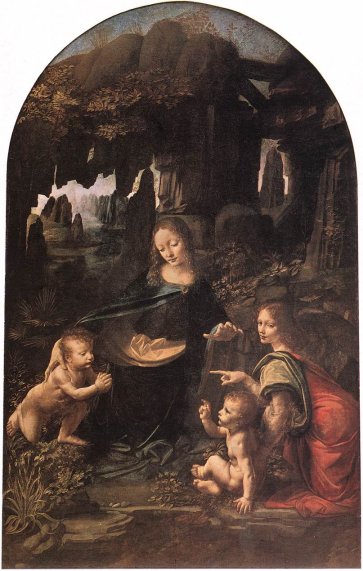
|
|
Virgin of The Rocks, Version One, Louvre, 1483 Notice the pointing finger of contempt from the Angel to John the Baptist. |
The Louvre version is generally accepted as Leonardo's, but there is continuing doubt about the National Gallery version.
In any event, the compositional changes reveal to us, apparently, what the Confraternity objected to. They obviously objected to the angel, seated beside the infant Jesus, pointing at the infant John the Baptist. They probably asked for halos to be included, but I think Leonardo added the "reedy cross" across the shoulder of John on his own initiative.
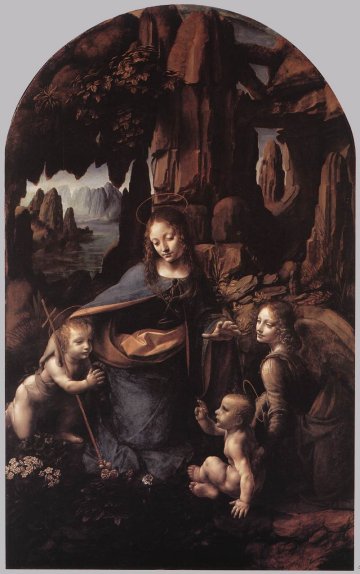
|
|
|
The paintings are about equal in size, but the figures in the second version are brought closer to the viewer and made "heavier" and "more idealized" as though they are made of stone. The colors of the second version have been subdued to the point of actually looking as though they are dead bodies - a corpselike pallor seems to deliberately emphasize that the "message" of the painting is "death."
The item in the first painting that has received the most comment is the strange, almost threatening hand of the Virgin in version One of the painting. Let's look at the hands from the two versions side by side, keeping in mind all of Leonardo's comments about "telling a story" with his paintings, the gestures of the hands, and so on. I don't think the hand is threatening at all, as we will soon discover.
 |
 |
Now, let's take a look at another of Da Vinci's works: The Last Supper...
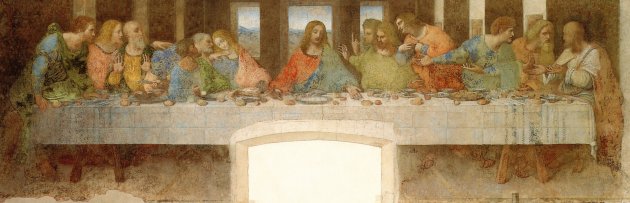 |
The Last Supper is said to be the "freezing of a moment in time," the moment when Christ has just spoken the words, "One of you shall betray me," and the disciples all react to the words with magnificent displays of poses and gestures, "revealing the intentions of their souls." Leonardo undoubtedly made many studies before he began to paint, but only two of them are left to us today. One of them is hastily - even roughly - drawn and shows ALL of the figures, even if they are not lined up in a row behind the table. Unable to place all of them at the table because of the small size of the page he was drawing on, he placed four of them at the bottom. BUT, his intention was clear because he placed a repeated shoulde/arm of one of the disciples at the left of the upper row. In the sketch, Leonardo was keeping to the standard iconographic style, leaving Judas sitting alone on the near side of the table.
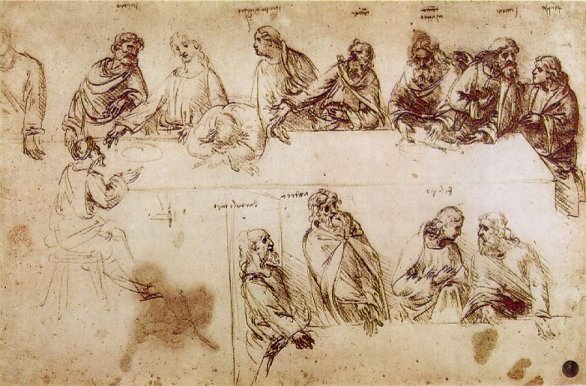
|
| Looking at the study for the Last Supper, we realize that Leonardo began with the "standard" ideas, but somewhere along the way he decided to do something remarkably different. |
What seems to be the case is that, beyond freezing this moment in time, Leonardo also intended other, deeper meanings as we can well surmise from his commentaries on painting quoted above, compared with the study above and the finished painting.
Many individuals have made much of the fact that this painting is supposed to depict Jesus dining with his “wife,” Mary Magdalene next to him. I certainly agree that the figure next to Jesus is obviously a woman - a woman who is missing from the preliminarry study unless she is the one who has all but collapsed face down next to Jesus, but is it Mary Magdalene? Or is it someone else? Or is the clue meant to point to something else altogether?
But, before I go further, let me suggest, from Leonardo's own words, a possible meaning of the two figures, appearing almost as twins, facing somewhat away from each other, yet joined by the proximity of their draped arms resting side by side on the table, forming the "M", that may take us one step deeper:
Pleasure and Pain represent as twins, since there never is one without the other; and as if they were united back to back, since they are contrary to each other. [...] This represents Pleasure together with Pain, and show them as twins because one is never apart from the other. They are back to back because they are opposed to each other; and they exist as contrairies in the same body...
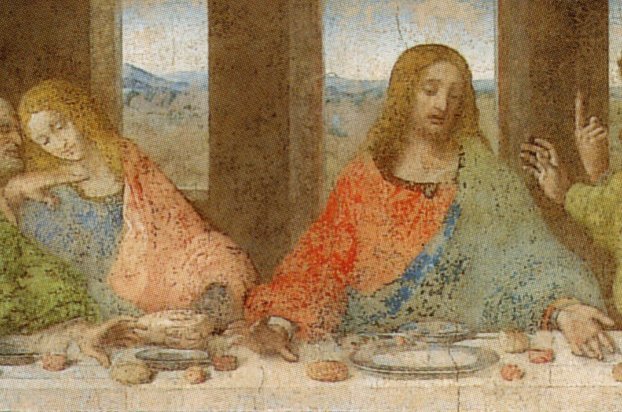
Leonardo also had formulas for the hands that were to "match" the nature of the discourse of the subject of the painting:
When you wish to represent a man speaking to a number of people, consider the matter of which he has to treat and adapt his action to the subject. Thus, if he speaks persuasively, let his action be appropriate to it. If the matter in hand be to set forth an argument, let the speaker, with the fingers of the right hand hold one finger of the left hand, having the two smaller ones closed; and his face alert, and turned towards the people with mouth a little open, to look as though he spoke.
Considering the announcement that Jesus is supposed to have just made in the Last Supper, the aspect of his hands is most interesting. We notice the supplicating gesture of the left hand, but the right hand is truly curious. It was only after I had looked at it for a bit that I realized what it reminded me of: The Virgin of the Rocks. Let's look at the hands side by side:
|
|
|
| Jesus hand, Last Supper | Mary's hand, Louvre | Mary's hand, London |
We actually see that the right hand of Jesus in the Last Supper matches almost exactly the left hand of Mary in the Virgin of the Rocks. In other words, whatever was being "said" by the hands in both paintings was the same thing. But, of course, in the Last Supper, according to the "plot" of the story, Jesus was about to take up a piece of bread and dip it in the bowl together with Judas whose hand is also reaching in a strange way. Is the implication that John the Baptist, in the Virgin of the rocks, was a sort of "Judas?"
Another controversy about the Last Supper has to do with the two “anomalous hands” in the painting. In the following image, I have taken a high resolution scan of a professional photograph purchased on site in Milan by a member of the Quantum Future School. (No photos are allowed to be taken by tourists.) I enlarged the photo and circled each evident or partly evident hand in the painting. I have placed a number above the head of each individual showing how many hands THAT particular individual has showing. I then cut the image so that I could fit it on the page in two parts.
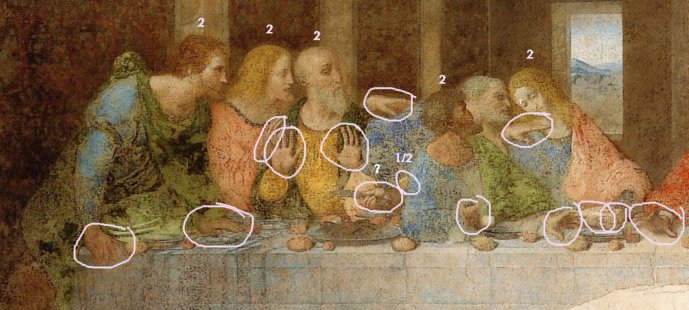 |
| I have placed question marks over the "questionable" hands, the one holding the knife which seems to belong to the man whispering in the woman's ear. Also, I would suggest that the his other hand, making the "head cutting" motion at the woman's neck is not altogether anatomically impossible, but it is certainly awkward. But perhaps "awkwardness," or "twistedness" is what Leonardo intended to convey about St. Peter? |
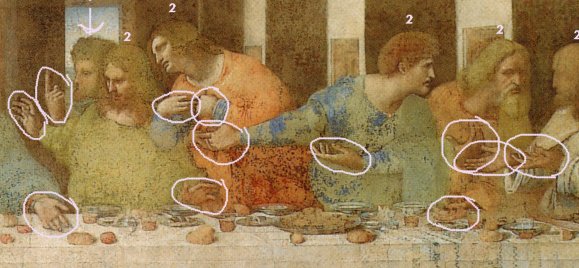
|
| Above, you see the one person with only ONE hand in view, his upraised finger pointing insolently to heaven as in the St. John painting, Leonardo's last painting. |
There are thirteen people at the table and, if we count the hands, we have 25, because one hand is hidden: the one belonging to the man with the upward pointing finger.
The figure whispering in the ear of the woman has been identified as St. Peter. One of the hands that must belong to him is found making a “cutting motion” at the throat of the woman seated next to Jesus.
It is obvious that Leonardo intended to convey a message because he spoke clearly enough about completing bodies that are to be behind other bodies so that the anatomy might be accurate. Here we have the only other study from the Last Supper known to be extant, next to the arm of St. Peter from the painting:
 |
 |
It is clear that the hand with the knife and the hand making the cutting motion at the neck of the woman both belong to St. Peter.
Let's look again at what Leonardo wrote:
The figure is most admirable which by its actions best expresses the passion that animates it.
...when you place one figure behind another take care to draw the whole of it so that the limbs which come in front of the nearer figures may stand out in their natural size and place.
You must show a man in despair with a knife.... A picture or representation of human figures, ought to be done in such a way as that the spectator may easily recognise, by means of their attitudes, the purpose in their minds. ...The motions of men must be such as suggest their dignity or their baseness.
Make your work carry out your purpose and meaning. That is when you draw a figure consider well who it is and what you wish it to be doing.... Represent your figures in such action as may be fitted to express what purpose is in the mind of each... Envy must be represented with a contemptuous motion of the hand towards heaven, because if she could she would use her strength against God...
So, most certainly, not only might we have "Twin Representations" in the figures of Jesus and the woman to his right as the "Pleasure, Pain Principle," but also the hand holding the knife that emerges from behind Judas Iscariot is holding a knife: "You must show a man in despair with a knife..." and, if we suppose that the bread, the Eucharist, is to represent "the body of Christ," then the action of the knife over the bread might very well be Envy making a "contemptuous motion of the hand towards heaven." Put that together with the head cutting motion and the whispering in the ear: conspiring, and a rather unpleasant picture of St. Peter emerges. It seems that Peter is hiding his actions behind Judas.
Curious.
As I continued to study this painting, I noted something else that seems to be quite remarkable:
If you use the hand with the knife, the hand making the cutting motion, the right hand of Jesus, his forehead, and the palm of his left hand as “points,” you have exactly traced the constellation of Cassiopeia MIRRORED.
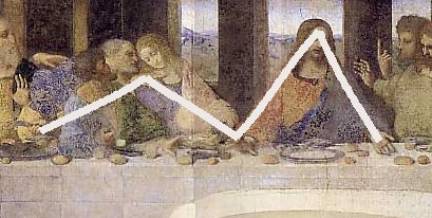 |
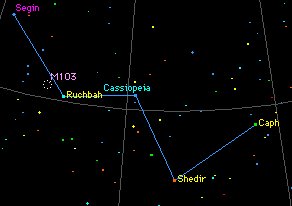 |
Now, in order to understand the possible implications of this strange figure that is clearly evident in the painting, let me repeat again the somewhat obscure information about this famous Star group cited earlier in this article.
"The star's name comes from a star picture envisioned by the Arabic peoples that is very different from the Greek conception of the constellation," Teske explains. "Despite this, its Arabic name was inserted into the Greek conception of Cassiopeia around 400 years ago."
That would put the insertion of the Arabic names right around the time of Da Vinci and the circle connected to Auch Cathedral. So, certainly they were aware of the following:
The Arabic names of the main stars of Cassiopeia give some clues to the esoteric meaning of the constellation, among them being “breast,”(schedir-seder?) “hand,” “hump of the camel,” “knee,” and “elbow,” all of which are esoteric symbols found in many arcane works. The Arabs called the entire constellation the seder tree. Earlier Arabs thought that this constellation was “the large hand stained with henna,” the brightest stars being the fingertips.
Which reminds us again of the strange, large hand of the Virgin of the Rocks, the hand that is the mirror image of the right hand of Jesus in the painting of the Last Supper.
Cassiopeia is a beautiful constellation at the end of the Milky Way Galaxy and is associated with what is known as the Perseus Constellation Family. It is in the zodiacal sign of the Ram wherein one finds the stars Shedir, “The Breast,” (the star on the forehead of Jesus), Ruckbah, (knee) “The Enthroned,” (the star on the hand making the cutting motion at the throat of the woman next to Jesus), and Dat al-Cursa, “The Seated.” The Chinese called Cassiopeia Ko Taou, or a “doorway.” Some saw this constellation in the shape of a key.
Hanging nearly overhead in November's mid-evening sky is the W-shaped constellation we know as Cassiopeia... Observers who face north will see the star called "Caph," meaning the palm of a hand, on the left end of Cassiopeia's upside-down "W."
Interesting that there is the "palm of the hand" and the "palm branch," located at the upturned palm of Jesus? Also strange that Cassiopeia is referred to as being an "upside down W rather than the more obvious M - an attempt to "hide" a relationship?
In 1893, E. W. Bullinger wrote about Cassiopeia:
The captive delivered, and preparing for her Husband, the Redeemer. In the last chapter we saw the woman bound (Andromeda); here we see the same woman freed, delivered, and enthroned.
ULUGH BEY says its Arabic name is El Seder, which means the freed.
With the hands of the woman in The Last Supper clasped together as though "bound," and the cutting motion being made by St. Peter, concealing his knife, we certainly can see a relationship here.
In the Denderah Zodiac (Egyptian) her name is Au-Set - Isis - which means set up as Queen. ALBUMAZER says this constellation was anciently called "the daughter of splendour." This appears to be the meaning of the word Cassiopeia, the enthroned, the beautiful. The Arabic name is Ruchba, the enthroned. This is also the meaning of its Chaldee name, Dat al cursa. There are 55 stars in this constellation, of which five are of the 3rd magnitude, five of the 4th, etc.
This beautiful constellation passes vertically over Great Britain every day, and is easily distinguished by its five brightest stars, forming an irregular "W." This brilliant constellation contains one binary star, a triple star, a double star, a quadruple star, and a large number of nebulae. In the year 1572 Tycho Brahe discovered in this constellation, and very near the star k (under the arm of the chair), a new star, which shone more brightly than Venus. It was observed for nearly two years, and disappeared entirely in 1574.
The brightest star, a (in the left breast), is named Schedir (Hebrew), which means the freed. The next, b (in the top of the chair), likewise bears a Hebrew name - Caph, which means the branch; it is evidently given on account of the branch of victory which she bears in her hand. She is indeed highly exalted, and making herself ready. Her hands, no longer bound, are engaged in this happy work. With her right hand she is arranging her robes, while with her left she is adorning her hair. She is seated upon the Arctic circle, and close by the side of Cepheus, the King. This is "the Bride, the Lamb's wife, the heavenly city, the new Jerusalem," the "partakers of the heavenly calling."
Cassiopeia is visible all night and all year and neither rises or sets, but instead circles endlessly around our northern Pole star [Polaris]. The Big Dipper is located on the opposite side of the pole to Cassiopeia.
The Lithuanians refer to the stars in Cassiopeia as 'Rider', 'Justandis ' or 'food carrier' - breast? - or 'Abakukas' Star' and 'Mary's stars'. This brings us to what. Sir John Rhys wrote about Cassiopeia:
We have to look for help to enable us to identify the great ‘SHE’ persistently eluding our search in the syntax of the Welsh language. Only two feminine names suggest themselves to me as in any way appropriate: One is Tynghed, ‘fate or fortune,’ and the other is Don, mother of some of the most nebulous personages in Celtic literature.
It is from Don that Gwydion, the bard and arch-magician, and Gofannon the smith his brother, are called sons of Don; and so, in the case of Arianrhod, daughter of Don, mother of Ilew, and owner of the sea-laved castle of Caer Arianrhod, not far distant from the prehistoric mound of Dinas Dinlle...
In Irish legend, we detect Don under the Irish form of her name, Danu or Donu, genitive Danaan or Donaan, and she is almost singular there in always being styled Divinity. From her the great mythical personages of Irish legend are called Tuatha De Danaan, or ‘the Goddess Danu’s Tribes,’ and sometimes Fir Dea, or ‘the Men of the Divinity.’
The last stage in the Welsh history of Don consists of her translation to the skies, where the constellation of Cassiopeia is supposed to constitute Ilys Don, or Don’s Court.[5]
Was Leonardo da Vinci indicating Cassiopeia in his painting of the Last Supper? Were Marguerite of Navarre, Rabelais, Nostradamus, Francis I, Anne Boleyn, and others, part of a group in contact with "Us in the Future?"
So, let me return now to the remarks about stars made by Canseliet made 20 years apart, that, juxtaposed, reveal something quite marvelous:
From the FIRST edition: I know, not from having discovered it myself, but because I was assured of it by the author more than ten years ago, that the key to the major arcanum is given quite openly in one of the figures, illustrating the present work. And this key consists quite simply in a colour revealed to the artisan right from the first work.
I suspect that the reader has, by now, figured out that Canseliet and Fulcanelli were very tricky. And so, we look at this clue and try to think of what Canseliet is saying. He says that the clue is in a “figure illustrating the present work,” that it is revealed “right from the first work” and in the preface to the second edition, adds the clue that the subject of the star “leads us straight into Fulcanelli’s text” saying that “right from the beginning my Master has dwelt on the primary role of the star…”
We turn again to the very beginning of Fulcanelli’s text:
The strongest impression of my early childhood - I was seven years old - an impression of which I still retain a vivid memory, was the emotion aroused in my young heart by the sight of a gothic cathedral. I was immediately enraptured by it. I was in an ecstasy, struck with wonder, unable to tear myself away from the attraction of the marvellous, from the magic of such splendour, such immensity, such intoxication expressed by this more divine than human work.
Varro, in his Antiquitates rerum humanorum, recalls the legend of Aeneas saving his father and his household gods from the flames of Troy and, after long wanderings, arriving at the fields of Laurentum, the goal of his journey. “Laurente (Laurentium) is cabalistically l’or enté (grafted gold)”. And so indeed, we have been led to a color!
Abbe Boudet:
The Auscii easily became skillful in working in gold; this metal was almost like a weed in their region, and diverse historians say that the avid Greek and Phoenician merchants, coming back to their countries, used the gold gathered in the Pyrénées for ballast in their vessels.
Is the Da Vinci Code also the Mystery of the Cathedrals we have been led to by Fulcanelli?
Patrick Rivière, alchemist, student of Eugene Canseliet, disciple of Fulcanelli:
Throughout her exposé, Laura Knight-Jadczyk refers to two powerful works of the scientist-alchemist Fulcanelli: The Mystery of the Cathedrals and Dwellings of the Philosophers. She applies her vast knowledge to the continuation of his work. [...]
As to her inspiration, what can we say, and, from whence could it come, if not the Light of the stars? [Patrick Rivière's Preface to The Secret History of the World]
[1] In my partial autobiography, Amazing Grace, I have discussed, at some length, many of the surpassingly strange events that began shortly after I was born, and which have continued to the present day, that give evidence of the fact that there is, indeed, within mysterious groups, some sort of extraordinary interest in my existence and work. It is clear from the objective evidence that some of these groups do not wish to kill me, but most definitely wish to control me, while others wish to protect me and ensure that I succeed in some “mission” of which I have very little conscious awareness, but apparently, am discovering in a satisfactory way “one step at a time.”
3] Inserted into text.
You are visitor number .